

Why Am I So Irritable? The Pattern Psychologists See Behind Constant Frustration
Rod Mitchell, MSc, MC, Registered Psychologist
Key Highlights
Nearly 40% of people with depression report irritability as a significant symptom, making it one of the most overlooked mood indicators.
Effective therapy for anger and irritability identifies whether physical causes, mental health conditions, or life stress drives your low tolerance.
Irritability creates a self-perpetuating cycle: stress hormones stay elevated, you interpret situations more negatively, and withdrawal eliminates your support system.
Most people see improvement within 2-4 weeks using targeted strategies, though persistent patterns may need professional assessment and specialized treatment.
In my years working with clients struggling with mood regulation, I've noticed something striking: most people who come in feeling constantly irritable believe something is fundamentally wrong with them. The reality? Irritability is rarely a character flaw - it's usually your nervous system sending an urgent signal that something needs attention.
When clients ask "why am I so irritable," they're often surprised to learn their short fuse isn't about having less patience than others. Persistent irritability typically points to identifiable causes, and understanding the source is the essential first step toward feeling more like yourself again.
This article explains:
Why irritability becomes self-perpetuating
Why simply "trying harder" to control it rarely works
The physical, psychological, and situational factors that create irritability
Immediate coping strategies for the factors that might be affecting you
Once you understand what's driving your irritability, developing stronger emotional regulation skills becomes essential for lasting change. Our article "What I Teach My Clients About Emotional Regulation Skills" provides practical techniques to respond more effectively to difficult emotions rather than being overwhelmed by them.
Table of Contents Hide
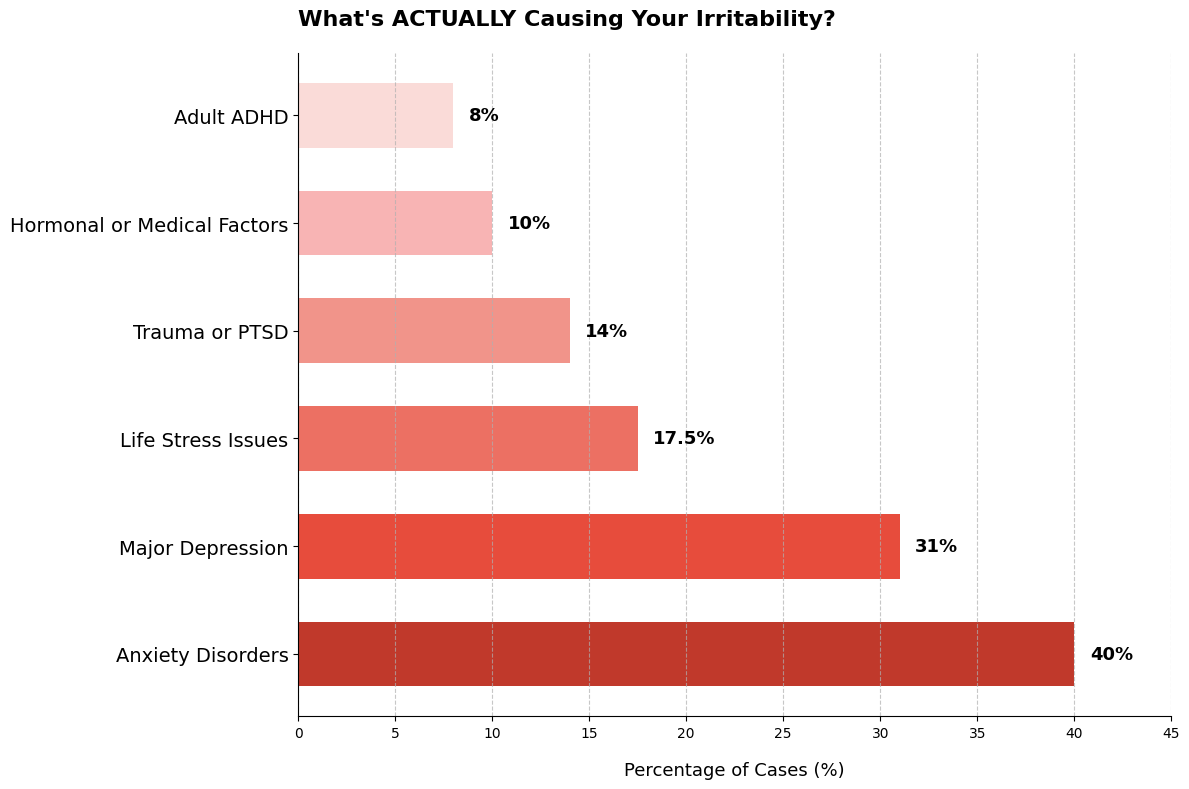
When mental health professionals evaluate adults seeking help for persistent irritability, anxiety disorders are the most common underlying cause - not depression, as many assume.
Anxiety accounts for 38-42% of cases, followed by depression (28-34%). Significant portions also stem from life stress (15-20%), trauma (12-16%), hormonal factors (8-12%), and ADHD (6-10%).
Understanding that irritability has many possible roots helps explain why simple stress management alone often isn't enough.
What Is Irritability, Really?
Irritability is a state where you feel annoyed or impatient in response to situations that wouldn't normally bother you - or wouldn't bother you this much.
It's not the same as anger.
Anger typically has a clear trigger and target. Irritability is more diffuse - everything feels frustrating, even minor inconveniences that should roll off your back.
| Normal Frustration | Irritability |
|---|---|
| Specific trigger causes reaction | Everything feels annoying |
| Response fits the situation | Reaction disproportionate to cause |
| Resolves when issue addressed | Persists without clear reason |
| Limited to specific contexts | Pervades multiple life areas |
You might snap at your partner over dishes left in the sink, feel rage about your coffee being slightly too hot, or find yourself furious about a crooked picture frame. The mismatch between trigger and reaction is the telltale sign.
Dr. Ellen Leibenluft, Chief of the Section on Mood Dysregulation and Neuroscience at the National Institute of Mental Health, explains: "Irritability is not simply mild anger or frequent anger - it's a state of heightened threat sensitivity where the threshold for anger is chronically lowered. People experiencing irritability are essentially walking around with their emotional alarm system set too sensitively."
This heightened sensitivity has a neurological basis. Research shows that irritable individuals demonstrate 30-40% greater brain activation to mildly frustrating stimuli compared to others - their brains literally interpret neutral situations as more threatening.
Why this matters:
Relationships suffer when loved ones feel like they're walking on eggshells around you
Work performance declines as concentration and patience diminish
Your wellbeing erodes from the constant tension and exhaustion of feeling on edge
Guilt accumulates after outbursts you regret but struggle to prevent
Nearly everyone experiences irritability sometimes - during stressful periods, when sleep-deprived, or dealing with difficult circumstances.
When it becomes your baseline state, that's when understanding the cause becomes essential.

Physical Causes of Irritability
Your body's physiological state directly influences how you handle frustration.
When these physical systems are off-balance, even minor irritations feel overwhelming:
Sleep disruption impairs the connection between your emotional control center and alarm system
Blood sugar swings trigger stress hormones that override measured responses
Hormonal imbalances alter brain chemistry affecting mood stability
Chronic pain or illness depletes your capacity to manage additional stress
Caffeine and medications can create cycles of stimulation and crash
Sleep: Quality Matters More Than You Think
Most articles tell you to get 8 hours of sleep. That's incomplete advice.
Research shows that sleep fragmentation - waking multiple times throughout the night - causes 60% less positive emotional response even when total sleep time seems adequate. Your brain needs continuous sleep cycles to maintain emotional regulation capacity.
While many articles recommend 8 hours of sleep as the solution, years of treating mood issues have taught me that sleep quality matters as much as quantity.
I've worked with clients who sleep 8 hours but wake exhausted - often pointing to sleep disorders like sleep apnea that need addressing. Their irritability doesn't improve until we address the quality issue, not just the hours in bed.
The "Hangry" Phenomenon Is Real
That rage you feel when lunch is delayed isn't just in your head.
Studies found that blood sugar variability - the fluctuation between high and low - produces 38% stronger aggressive responses than sustained low glucose. Your prefrontal cortex, which manages self-control, requires steady glucose to function properly.
Picture this: you skip breakfast, grab a sugary coffee mid-morning, then crash by 11 AM feeling irritable at everyone. The problem isn't hunger alone - it's the glucose roller coaster affecting your brain's ability to regulate frustration.
Hormonal Changes Beyond Reproduction
PMS and perimenopause get attention for mood effects, but thyroid dysfunction and cortisol imbalances fly under the radar.
Thyroid hormones regulate metabolism and mood. When levels drop - even at the low end of "normal" ranges - irritability often appears before other symptoms.
Chronic stress creates cortisol patterns that keep your nervous system stuck in overdrive. You're essentially walking around with your threat detection system turned up too high.
Pain, Caffeine, and Medications
Chronic pain or illness constantly drains your capacity to handle additional frustration. Every interaction requires energy you don't have.
Caffeine creates a stimulant-crash cycle that mimics the blood sugar problem - temporary alertness followed by irritability as effects wear off.
If you suspect medication is contributing to your irritability, do not discontinue it without consulting your prescribing physician.
Some medications - including certain blood pressure drugs, corticosteroids, and hormonal contraceptives - can affect mood as a side effect. This requires medical guidance to address safely.
Mental Health Conditions Causing Irritability
Studies show that nearly 40% of people with major depressive disorder report irritability as a significant symptom - yet most never connect their constant frustration to depression.
The disconnect happens because we expect depression to look like sadness and withdrawal. When it shows up as anger and low tolerance, people miss it entirely.
Depression: The Anger Connection
Depression disrupts the brain's emotional regulation systems, creating a state where minor frustrations trigger disproportionate reactions.
The "anger-turned-inward" theory suggests that when people can't express or process anger appropriately, it manifests as depression. But the reverse also happens - depression itself creates irritability by impairing the prefrontal cortex's ability to manage emotional responses.
Men especially experience depression as irritability rather than sadness. Research shows that 55% of depressed men report irritability as their primary symptom, compared to 32% of women.
In my practice, I frequently observe that men are genuinely surprised to learn their constant frustration and low tolerance are actually depression symptoms. They'll describe feeling "pissed off at everything" but resistant to the word "depressed" because they're not crying or feeling sad.
When you're depressed, everything requires more effort. That creates a shorter fuse - not because you lack patience, but because your brain is already working overtime just to function.
If you're experiencing thoughts of self-harm or suicide, please seek immediate help. Contact the 988 Suicide and Crisis Lifeline (call or text 988) or go to your nearest emergency room.
Anxiety: The Hypervigilance Pathway
Anxiety keeps your nervous system stuck in "on" position, constantly scanning for threats.
This hypervigilance makes everything feel like a potential problem. Your colleague's email isn't just a request - your brain flags it as criticism. Traffic isn't just slow - it's a threat to your control and schedule.
Working with anxiety clients has shown me that the hypervigilance-to-irritability pathway is often invisible to the person experiencing it. They know they feel "on edge" but don't connect it to underlying anxiety driving constant threat detection.
Picture sitting in a crowded restaurant where you can't see the exits. That trapped, frustrated feeling? For someone with anxiety, mundane situations trigger that same response - except they don't recognize the anxiety underneath.
Trauma and PTSD
Trauma fundamentally rewires the nervous system's threat detection threshold.
What looks like irritability is often a survival response - your brain interpreting neutral situations as dangerous based on past experiences. The heightened reactivity served you during the traumatic period. Now it's creating problems.
Trauma-related irritability often appears months or even years after the triggering event. People don't connect their current frustration to past trauma, especially with single incidents like accidents or assaults.
This pattern needs specialized trauma-informed therapy approaches that address the nervous system dysregulation, not just the irritability symptom.
Other Conditions to Consider
ADHD creates irritability through impaired impulse control and frustration with executive function challenges. Bipolar disorder may show irritability during both manic and depressive episodes. Disruptive Mood Dysregulation Disorder in children and adolescents centers on chronic irritability.
Ask yourself these questions:
Has my irritability persisted for two weeks or more, most days?
Do I notice other symptoms alongside irritability - sadness, worry, sleep changes, concentration problems?
Does my irritability seem disproportionate to what's triggering it?
Have others expressed concern about changes in my mood or temper?
Is my irritability affecting my relationships, work, or daily life?
If you answered yes to multiple questions, professional assessment can determine whether an underlying condition needs treatment.
Life Stress and Irritability
Sometimes irritability isn't about what's happening inside your body or brain - it's about the sheer weight of what's happening in your life.
The circumstances that most commonly overwhelm emotional regulation:
Chronic stress from juggling too many responsibilities simultaneously
Decision fatigue from hundreds of daily choices depleting mental resources
Workplace burnout after months of high demands without recovery
Relationship conflict creating constant background tension
Financial stress threatening basic security
Major transitions like job changes, moves, or loss
Research reveals a crucial pattern: managing 1-2 major stressors produces modest irritability increases, but facing 3 or more simultaneous stressors creates an exponential jump in emotional reactivity. Your regulatory systems reach a tipping point where they become overwhelmed.
Decision Fatigue: The Hidden Drain
Consider a typical morning: what to wear, what route to take, which work project to tackle first, how to respond to your partner's text, whether to attend that meeting, what to eat for lunch.
By noon, you've made dozens of decisions.
Studies show that just 4 hours of sustained decision-making depletes glucose in your prefrontal cortex and produces 60% more hostile responses to minor frustrations. This explains why people often feel most irritable in late afternoon - it's not the time of day, it's the cumulative mental load.
Picture standing in the grocery store, overwhelmed by cereal choices while your phone buzzes with work emails. That spike of irritation isn't about cereal - it's your depleted decision-making capacity signaling overload.
When Stress Accumulates
Workplace burnout develops gradually. High demands feel manageable initially as you deploy coping resources. After 3-4 weeks without relief, those resources deplete and irritability emerges.
Relationship stress operates differently - it creates constant background activation that makes everything else feel harder. Financial worries produce particularly intense irritability because they threaten basic security, activating more primitive threat-detection systems.
Dr. Robert Sapolsky, professor of biology and neurology at Stanford University, explains: "Each stressor deposits biological and psychological debris that makes the system more reactive. By the time someone is managing multiple chronic stressors, their irritability isn't a character flaw - it's a neurobiological inevitability."
Major life transitions - even positive ones like promotions or moves - require sustained adaptation that taxes your emotional resources. The irritability often peaks 4-8 weeks after the change, once initial adrenaline fades and the grinding reality of adjustment sets in.
Recognizing that your circumstances alone can create irritability isn't making excuses - it's understanding that emotional regulation requires capacity, and overwhelming situations exceed that capacity.
The next section reveals why irritability becomes self-perpetuating once it starts, making it feel impossible to escape.

Why Irritability Gets Worse: The 4 Component Cycle
Irritability doesn't just persist - it actively builds on itself.
Research tracking people over 8 weeks found that untreated irritability created a 73% increase in episodes as the pattern strengthened. This happens because irritability operates through four interconnected components that reinforce each other, making the cycle progressively harder to interrupt.
The Four Components That Keep You Stuck
Physiological component: Your stress hormones stay elevated from constant irritability, keeping your nervous system in overdrive. This lowers your threshold for the next trigger - you're essentially walking around with your alarm system set too sensitively. What required significant provocation initially now gets triggered by minor annoyances.
Cognitive component: You develop a negative interpretation bias where you automatically see threat or criticism in neutral situations. A colleague asking "Do you have a minute?" gets interpreted as an attack on your productivity rather than a simple request. This pattern makes you perceive your environment as more hostile than it actually is.
Behavioral component: You start avoiding situations or people that might trigger irritability. This withdrawal prevents you from addressing underlying problems, so they accumulate. Avoided conversations become bigger issues. Dodged responsibilities pile up. The triggers multiply instead of resolving.
Relational component: Your irritability pushes people away - partners withdraw, friends stop calling, colleagues avoid you. Research shows that 68% of people with chronic irritability engage in social withdrawal, eliminating the support system they need most. Isolation deepens the cycle.
Dr. Ellen Leibenluft, leading researcher on chronic irritability, explains this progression: "The brain learns irritability much like it learns any repeated behavior. Each episode strengthens the neural pathways involved, making those pathways more easily activated."
A pattern I consistently notice: when people become irritable, they often withdraw from relationships to "protect" others from their mood.
Ironically, this isolation eliminates their support system exactly when they need it most. The people who could provide perspective, encouragement, or simply distraction disappear - deepening the cycle.
Signs You're Caught in the Cycle
Ask yourself:
Does your irritability seem worse now than when it started?
Are smaller things triggering you than before?
Do you find yourself interpreting neutral interactions negatively?
Have you withdrawn from people or activities you used to enjoy?
Do relationships feel strained or distant?
Does controlling your reactions feel harder despite trying?
If you answered yes to three or more, you're likely experiencing the self-reinforcing pattern.
Why "Trying Harder" Doesn't Work
The cycle's interconnected nature explains why willpower alone rarely succeeds.
Addressing only one component - like trying to "think more positively" - leaves the other three active. Your elevated stress hormones, avoidance patterns, and eroded relationships continue feeding the cycle.
Breaking free requires a multi-faceted approach that interrupts multiple components simultaneously. The next sections provide practical strategies and help you determine when professional support can address the full system more effectively.
How Irritability Impacts Your Life
Irritability doesn't stay contained in your head.
It shows up in your body, affects how you experience emotions, and ripples outward into every part of your daily life.
Physical Signs You're Irritable
Your body carries irritability in distinct ways. Research shows that 68% of chronically irritable people report jaw clenching or teeth grinding - often without realizing they're doing it.
Other common physical symptoms include:
Muscle tension across shoulders, neck, and lower back
Racing heart or chest tightness during minor frustrations
Tension headaches that worsen throughout the day
Clenched fists or hands you don't notice until someone points them out
Digestive distress when stressed or frustrated
Picture sitting through a family dinner where conversation topics grate on you. Your jaw tightens, shoulders creep toward your ears, and by dessert you have a pounding headache - even though nothing objectively terrible happened.
Emotional Experience of Irritability
Emotionally, irritability creates a constant state of impatience.
You feel agitated by normal delays - waiting for your coffee to brew, sitting through a meeting, listening to someone tell a story. Everything that requires patience feels unbearable.
The most distressing part? Difficulty controlling your reactions even when you know they're disproportionate. You snap at your child for asking a reasonable question, then immediately regret it. You send a harsh text to a friend, recognizing as you hit send that you're overreacting.
Where Irritability Damages Your Life
The impacts extend far beyond the irritable moments themselves:
In relationships:
Increased conflicts over minor issues
Partner or family members describe "walking on eggshells"
Guilt and shame after outbursts create emotional distance
Apologies feel hollow when the pattern repeats
At work:
Concentration suffers - you can't focus when everything feels frustrating
Motivation drops as tasks feel overwhelming
Colleagues avoid you or interactions feel strained
Performance suffers even if you're technically competent
For your overall wellbeing:
Exhaustion from constant tension and emotional reactivity
Feeling out of control of your own responses
Withdrawal from activities you used to enjoy
Sense that you're not yourself - "this isn't who I am"
Think about your last irritable morning. Maybe you burned toast, snapped at your partner, felt rageful in traffic, then arrived at work already depleted. That's not just a bad mood - it's irritability affecting multiple life domains simultaneously.
Recognizing these patterns is validating, not pathologizing. When irritability pervades your experience this way, it signals that something needs attention - whether physical causes, mental health factors, or overwhelming life circumstances.
The next section provides immediate strategies for managing irritability while you work on addressing root causes.
Practical Strategies for Managing Irritability
Relief doesn't require hours of practice or complex techniques.
These evidence-based strategies work because they target the physiological systems driving irritability:
Deep breathing calms your nervous system in under 2 minutes
Physical movement shifts brain chemistry within 10-15 minutes
Sleep improvements restore emotional regulation capacity
Social connection prevents the isolation that deepens cycles
Trigger tracking reveals patterns you can address
Box Breathing: The 90-Second Reset
Research shows that box breathing - a structured 4-count pattern - reduces physiological arousal by 30 percent within 90 seconds (Balban et al., 2023).
The technique: Inhale for 4 counts, hold for 4, exhale for 4, hold for 4. Repeat for 2-5 minutes.
Picture waking up already irritable, tension building before you've left your bedroom. Two minutes of box breathing before starting your morning routine activates your parasympathetic nervous system - the brake pedal for your stress response.
Movement Changes Everything
Just 10 minutes of walking, climbing stairs, or stretching increases mood-regulating brain chemicals that reduce irritability for 1-2 hours afterward.
You don't need a gym membership or workout clothes. A quick walk around your building during lunch, taking stairs instead of the elevator, or doing jumping jacks in your living room all work.
The key is consistency. Daily 10-minute movement beats sporadic hour-long sessions.
Sleep Quality Matters
Focus on sleep hygiene basics: consistent sleep and wake times, cool dark room, screens off 30 minutes before bed, limiting caffeine after 2 PM.
If you're sleeping 7-8 hours but still waking exhausted, that signals a quality issue worth discussing with your doctor - possibly sleep apnea or other disorders affecting restoration.
The Power of Naming Your Emotion
My clients often tell me that simply naming their emotion - saying out loud or thinking "I feel irritated right now" - immediately reduces its intensity.
This aligns with research on emotion labeling. The act of naming activates your prefrontal cortex, which then regulates the amygdala's emotional reactivity. It sounds too simple to work, but the simplicity is exactly why it helps during moments when complex strategies feel impossible.
Connection and Self-Care
Prioritize brief social contact even when you don't feel like it - a 10-minute call with a friend, coffee with a colleague, texting someone you trust. Connection prevents the isolation that deepens irritability cycles.
Self-care doesn't mean bubble baths and spa days. It means protecting 15-20 minutes daily for something that genuinely restores you: reading, sitting outside, listening to music, any activity where you're not solving problems or managing others' needs.
Track Your Patterns
Notice when irritability strikes. After poor sleep? When hungry? During specific interactions? After scrolling social media?
Identifying patterns reveals addressable triggers rather than feeling randomly overwhelmed.
"The clients who do best implement strategies when irritability is at 3-5 on a 10-point scale - treating the spark before it becomes a fire." - Dr. Kristin Neff, University of Texas at Austin
Start with one strategy from this section. Practice it daily for one week before adding another. Sustainable relief comes from consistent small actions, not occasional heroic efforts.
When to Seek Professional Help
The most common question I hear: "How do I know if this is serious enough for therapy?"
Research shows that early intervention produces 40% better outcomes when treatment starts within 6 months of symptom onset, compared to waiting longer. The key isn't whether your irritability feels severe enough - it's whether it's persisting and interfering with your life.
Self-Assessment: Three Critical Questions
| Assessment Area | Ask Yourself |
|---|---|
| Frequency Test | Does irritability occur more than half of your days for 2+ weeks straight? |
| Impact Test | Is it affecting your work performance, relationships, or daily functioning? |
| Control Test | Have self-help strategies not helped within 2 weeks of consistent effort? |
Through clinical assessment, I've developed this framework from patterns I see with clients wondering if they should seek help.
If irritability meets all three criteria - frequent, impactful, and resistant to self-management - it's time for professional support. You're not overreacting or being dramatic.
What to Track
Before your appointment, monitor for one week: what time of day irritability peaks, what situations trigger it, how long episodes last, and what specific problems it creates (arguments, missed work, sleep disruption). This information helps clinicians identify patterns you might not notice.
Picture reviewing your week and realizing you snapped at your partner four evenings in a row, always around 7 PM when exhausted. That pattern points toward fatigue and stress management - specific targets for treatment.
Urgency Levels: When to Act
Schedule an appointment within 2-4 weeks if: Irritability is frequent and impacting relationships or work, but you're managing daily responsibilities and not in crisis.
Seek help this week if: You've had aggressive outbursts you regret, damaged important relationships, or feel completely unable to control reactions. You're functioning but barely.
Get immediate help if: You're having thoughts of harming yourself or others, experiencing rage that feels dangerous, or unable to meet basic responsibilities. Contact 988 Suicide and Crisis Lifeline or go to your nearest emergency room.
What Professional Assessment Involves
Your first appointment typically involves discussing symptom patterns, how long they've persisted, what you've tried, and how irritability affects your life. The clinician will assess for underlying conditions like depression or anxiety and recommend treatment approaches matched to your specific situation.
Most people leave the first session feeling relieved that someone understands their experience and has a plan for addressing it.
"Early intervention for persistent irritability is crucial because emotional response patterns become more ingrained over time. The brain's plasticity means early intervention is generally more effective and requires less intensive treatment." - Dr. Ellen Leibenluft, National Institute of Mental Health
Recognizing when you need help isn't weakness - it's the same judgment you'd use for persistent physical symptoms that don't improve with home care.
Conclusion
If you're asking "why am I so irritable," you're not broken.
Persistent irritability almost always has identifiable causes: physical factors like sleep deprivation, mental health conditions like depression showing up as frustration, or life circumstances exceeding your capacity. Understanding which factors drive your experience is the essential first step.
Recognizing how irritability becomes self-perpetuating - through elevated stress hormones, negative interpretation patterns, and withdrawn support - explains why willpower alone rarely works.
Five actions to take now:
Reflect on causes covered - what resonates with your experience?
Track patterns for 1-2 weeks: frequency, triggers, severity.
Implement 2-3 strategies consistently - start with box breathing and daily movement.
Use the assessment framework: if irritability occurs most days, impacts functioning, and self-help hasn't worked in two weeks - seek help.
Schedule consultation with a mental health professional for matched treatment.
Crisis support: 988 Suicide and Crisis Lifeline (call or text 988).
At Emotions Therapy Calgary, we specialize in emotion-focused treatment for persistent irritability. If you're in Calgary and irritability is impacting your life, we're here to help.
You deserve to feel like yourself again.