

What I Teach My Clients About Emotional Regulation Skills
Rod Mitchell, MSc, MC, Registered Psychologist

Key Highlights
Emotional regulation isn't eliminating feelings - it's responding effectively rather than reactively, a skill many confuse with harmful suppression.
Effective emotional regulation skills include creating pause space, naming emotions accurately, practicing acceptance, mindfulness, and cognitive reappraisal techniques.
Trauma, chronic stress, and unsafe environments genuinely limit your nervous system's regulation capacity, making techniques harder to access.
Research-backed approaches like DBT and anger management counselling help develop emotional regulation skills, with most people seeing meaningful improvement.
In my years of clinical practice, I've noticed something that surprises most clients: the people who seem most "in control" of their emotions often struggle the most. They've mastered not showing feelings - but underneath, they're exhausted, disconnected, and confused about why suppressing emotions makes them feel worse, not better.
Here's what I've learned: emotional regulation skills aren't about controlling, eliminating, or hiding what you feel. They're about developing a healthier relationship with your emotions - learning to recognize them as signals, respond to them effectively, and express them in ways that strengthen rather than damage your relationships and wellbeing. Research consistently shows that people who develop these skills experience better mental health, more satisfying relationships, and greater resilience during stress.
In this article, I will:
Explain what emotional regulation actually means (and what it doesn't)
Help you recognize when dysregulation is affecting your life
Provides practical techniques you can start using today
For those specifically struggling with anger management, our article "How CBT Helps You Manage Anger" offers targeted cognitive-behavioral strategies designed to transform how you understand and respond to anger triggers. If you're experiencing persistent irritability, "Why Am I So Irritable?" helps identify the underlying causes before applying regulation skills.
Table of Contents Hide
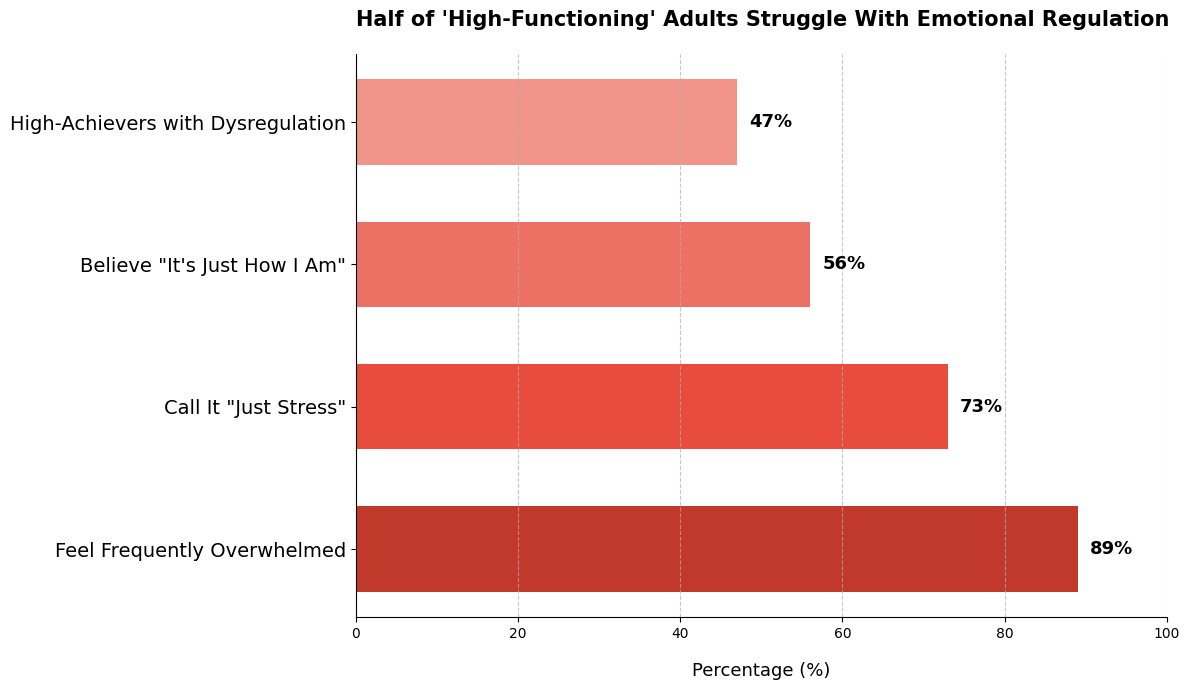
Emotional dysregulation hides in plain sight. Research on 5,692 adults found that 42% meet criteria for moderate-to-severe dysregulation - yet aren't in mental health treatment. Among high-achievers with advanced degrees and management roles, prevalence jumps to 47%, proving success doesn't equal emotion skills.
Over half (56%) believe their emotional responses are "just how I am" rather than learnable patterns. High-functioning adults wait an average of 8.7 years before seeking help - nearly a decade longer than those with visible life disruption - and 68% don't recognize their dysregulation as abnormal until a crisis like a relationship ending or job loss forces recognition.
If you've been telling yourself you're fine, you're probably not alone - and you're definitely not broken.
What Is Emotional Regulation?
Most people get this wrong.
They think emotional regulation means staying calm, not reacting, keeping feelings hidden. They pride themselves on "not being emotional" or "staying in control."
That's not regulation - that's suppression. And the difference matters more than most people realize.
Emotional regulation is the ability to influence which emotions you experience, when you have them, and how you express them. It's not about eliminating feelings or hiding them from others. It's about responding to emotions effectively rather than being driven by them or exhausting yourself trying to contain them.
| Suppression | Healthy Regulation |
|---|---|
| Hiding what you feel from others | Acknowledging what you feel internally |
| Pushing emotions down or away | Working with emotions as information |
| Appearing calm while stressed inside | Actually feeling calmer through effective strategies |
| Exhausting effort to "keep it together" | Sustainable approach to emotional experiences |
The distinction shows up clearly in how people feel. Suppression creates the illusion of control while emotional intensity builds underneath. Regulation actually shifts your internal experience.
What I See in My Practice
People often come to therapy describing themselves as "good at managing emotions."
They don't yell. They don't cry at work. They appear composed to others.
But they're exhausted. They feel disconnected. And they're confused about why anxiety keeps breaking through despite all their effort to "stay controlled." When we explore what they mean by "managing," it's usually suppression - working hard to hide feelings, not actually processing or responding to them.
What Healthy Regulation Actually Looks Like
Picture getting critical feedback in a meeting. Your chest tightens, face flushes, mind races with defensive responses.
Suppression means keeping your face neutral, saying "I'm fine," while rage churns inside for hours afterward.
Regulation means noticing the anger, recognizing it as information (this matters to you, you feel misunderstood), taking a breath before responding, and choosing whether to address it now, later, or let it go based on what serves you - not based on making the feeling disappear.
Your emotion informed your response. You didn't fight it or obey it blindly. You worked with it.
Lead Your Emotions, Don't Fight Them
The research behind emotional regulation, particularly James Gross's Process Model, frames emotions as natural responses to situations - not enemies to defeat. Effective regulation means influencing emotions at strategic points: choosing situations wisely, shifting your attention, reframing meaning, or modulating your expression.
It's about leadership, not warfare.
"Suppression is like putting a lid on a boiling pot without turning down the heat. The pressure just builds." - Dr. James Gross, Stanford University
Why This Distinction Changes Everything
When you confuse suppression with regulation, you keep using strategies that actually increase distress while believing you're doing the right thing. Research shows suppression predicts higher anxiety and depression over time - not because you're failing at it, but because it fundamentally doesn't work the way you think it does.
Understanding the real definition opens the door to strategies that actually reduce emotional intensity rather than just hiding it. That's what the rest of this article explores.

Why Emotional Regulation Techiques Matter
The stakes are higher than most people realize.
Poor emotional regulation doesn't just make you feel bad in the moment. It systematically damages the relationships, career opportunities, and health outcomes that determine your quality of life.
The Relationship Cost
Think about the last time a partner comment about money triggered instant defensiveness. Your chest tightened, words came out sharp, and within minutes you were rehashing old arguments instead of solving the actual problem.
That pattern - trigger to escalation to damage - is what dysregulation does to relationships. Research shows that people who habitually suppress emotions report 33% lower relationship satisfaction over time, while those lacking regulation skills struggle with conflict resolution, emotional intimacy, and building trust.
The impacts show up as:
Conflict escalation: Minor disagreements become major fights because emotional intensity overwhelms productive discussion
Emotional distance: Partners withdraw or shut down to avoid triggering reactions, creating isolation in the relationship
Trust erosion: Unpredictable emotional responses make others feel unsafe sharing concerns or needs
Repair difficulties: After conflicts, dysregulated people struggle to reconnect - they stay flooded with emotion long after the issue passes
The Professional Impact
At work, emotional dysregulation shows up in decision-making under pressure, stress management during deadlines, and professional interactions when stakes feel high.
Picture presenting to leadership when anxiety spikes. Without regulation skills, your mind goes blank, voice shakes, and you lose track of your points. With regulation skills, you notice the anxiety, use it as information about what matters to you, and channel that energy into engaged delivery.
The difference is career trajectory. People with stronger regulation skills navigate workplace stress more effectively, maintain professional relationships during conflict, and make clearer decisions when emotions run high.
The Mental and Physical Health Connection
Perhaps most concerning: chronic dysregulation predicts worse mental health outcomes over time.
The connection works both ways. Anxiety and depression make regulation harder, and poor regulation intensifies anxiety and depression. Breaking this cycle requires building regulation capacity - it's not just symptom management, it's addressing a core mechanism driving distress.
Physical health suffers too. Your body wasn't designed for constant emotional flooding. Chronic stress from poor regulation contributes to cardiovascular problems, weakened immune function, and inflammation-related conditions.
What I Hear From Clients
People describe life before learning regulation as "constantly firefighting" - always responding to the latest emotional crisis, never getting ahead of the pattern.
After developing these skills, the language changes. One client told me: "My emotions aren't driving the bus anymore. They're still there, I hear them, but I'm the one deciding where we're going." That shift - from reactive to responsive - changes everything.
Signs of Emotional Dysregulation
You might not even recognize it in yourself.
Most people don't walk around thinking "I have emotional dysregulation." They just notice they feel things intensely, struggle to bounce back from upsets, or find themselves doing things they regret when emotions run high.
Dysregulation exists on a spectrum. Everyone experiences moments of emotional overwhelm - that's not dysregulation. The distinction lies in frequency, intensity, duration, and how much these experiences interfere with your life.
What Dysregulation Actually Looks Like
Research identifies four key patterns that help people recognize dysregulation in their own lives:
Emotional intensity that surprises you - A coworker's neutral comment about your project triggers rage or despair that lasts hours
Difficulty returning to calm - After an upset, you're still distressed 3-4 hours later while others have moved on
Impulsive reactions under stress - You send angry texts, make sudden decisions, or say things you immediately regret
Avoidance behaviors - You use food, substances, shopping, or social media to escape uncomfortable feelings
Studies show 78% of people with dysregulation report disproportionate emotional intensity weekly, while 71% struggle to return to baseline after emotional activation.
What Triggers Dysregulation
Research reveals a clear pattern: interpersonal situations trigger 68% of dysregulation episodes.
Perceived rejection, criticism, or exclusion dominate. Critically, the actual severity matters less than your interpretation - feeling dismissed in a meeting can trigger the same intensity as overt criticism.
The Impact on Daily Life
Dysregulation creates measurable consequences across relationships, work, and decision-making:
Relationships: Partners report "walking on eggshells," never knowing what might trigger intense reactions
Work performance: Difficulty managing stress under deadlines, workplace conflicts occur nearly 3 times more frequently
Decision-making: Choices made during emotional activation become more impulsive, less aligned with long-term values
What I Notice in My Practice
Many clients arrive describing themselves as "too sensitive" or "overreacting." They've been told to "just calm down" so many times they believe something's fundamentally wrong with them.
What I see is nervous systems responding intensely to situations that genuinely matter - the problem isn't the feeling, it's lacking effective strategies to work with that intensity. Once they understand this as a skills gap rather than a character flaw, everything shifts.
Most people with emotional dysregulation don't lack feelings or strategies - they have too much of both. They experience emotions more intensely, more quickly, and for longer than others. - Dr. Marsha Linehan, founder of Dialectical Behavior Therapy
This Isn't About Pathology
Having these patterns doesn't mean you're broken or disordered.
It means your nervous system learned to respond intensely - often for good reasons related to early experiences or current circumstances. The capacity to regulate emotions is developable. Recognition is simply the first step toward building skills that match your emotional intensity.

When Emotional Regulation Is Actually Harder
Sometimes struggling isn't about needing to try harder.
The regulation techniques that work smoothly for some people feel impossible for others - not because of lack of motivation or effort, but because their nervous system doesn't have the capacity to access those strategies yet.
This distinction matters more than most clinicians acknowledge.
Capacity vs. Skills: A Critical Difference
Think of emotional regulation capacity like a computer's processing power. Skills are the programs you're trying to run.
Someone with intact nervous system capacity learns a breathing technique and implements it successfully within days. Their system has the resources to pause, engage the prefrontal cortex, and modulate the stress response.
Someone with compromised capacity knows the same technique but can't access it when they need it most. Their nervous system is already operating at maximum load just managing baseline threat - there aren't resources available to run new programs.
Research on poverty's neurobiological impact reveals this clearly. Studies found that adults who experienced childhood poverty showed measurably reduced connectivity between emotion centers and regulation centers in the brain, even decades later. Each additional year in poverty correlated with less neural capacity for dampening emotional responses - regardless of knowledge about regulation techniques.
What Limits Capacity
Ask yourself if these apply:
History of trauma or abuse (particularly in childhood or ongoing)
Current unsafe environment (violence, active threat, unstable housing)
Chronic high stress (poverty, discrimination, caregiving demands)
Sleep deprivation lasting months or years
Techniques work sometimes but fail unpredictably based on your state
If three or more apply, you're likely dealing with capacity limits, not just skill gaps.
The Window of Tolerance
Dr. Daniel Siegel describes an optimal arousal zone where regulation techniques actually work - your "window of tolerance." Inside this window, your prefrontal cortex stays online and you can implement strategies effectively.
Trauma, chronic stress, and systemic adversity narrow this window dramatically. What used to be manageable stress now pushes you outside your functional range. Your nervous system isn't broken - it's responding appropriately to real threat by prioritizing survival over regulation.
Research shows this isn't metaphorical. Brain scans reveal that when people operate outside their window, prefrontal cortex activity drops by 40-60 percent while survival-mode regions dominate. You literally don't have the neural resources online to use cognitive strategies in those moments.
What I Need to Be Honest About
If you're currently experiencing active trauma, abuse, or extreme ongoing stress, regulation techniques alone won't be enough.
I've watched clients berate themselves for "failing" at breathing exercises or mindfulness when their nervous system was doing exactly what it should - staying activated to protect them from real danger. The problem wasn't their effort. The problem was that their system needed stabilization before skill-building could work.
This isn't personal failure. It's biology responding to your environment. Safety and nervous system healing must come first, then techniques become accessible.
When people are chronically traumatized, they're functioning with a system that's organizing the environment around threat - making emotional regulation techniques largely inaccessible. - Dr. Bessel van der Kolk, Trauma Research Foundation
If this describes your experience, working with a trauma-informed therapist who understands nervous system stabilization becomes essential - not optional enhancement, but the foundation that makes everything else possible.
The 5 Core Emotional Regulation Skills
These aren't five different therapies or complicated techniques.
They're fundamental skills that work across situations - tools you can start building today, regardless of whether you're managing everyday stress or working through deeper struggles.
Emotion regulation isn't a single skill but a toolkit of strategies, and different tools work better for different situations. The prefrontal cortex acts like a conductor, coordinating these different strategies. - Dr. Kevin Ochsner, Professor of Psychology, Columbia University
Here are the five core skills, each addressing a different aspect of working with emotions:
Create Space Between Trigger and Response. When something triggers you - a critical email, a partner's tone, unexpected bad news - your nervous system wants to react immediately. This skill is about inserting a pause, even three seconds, before you respond. Research shows this simple practice reduces impulsive behaviors by 41% over eight weeks of consistent use. The mechanism: you're giving your prefrontal cortex time to come online before limbic-driven reactions take over. Try: Take one full breath before replying to difficult messages. Count to three before speaking when you feel defensive.
Notice and Name What You're Feeling. Most people experience emotions as vague discomfort - just "feeling bad" or "stressed." Getting specific matters. When you label emotions accurately - "I feel anxious about the presentation and frustrated that I'm unprepared" - you activate language-processing regions in your brain that naturally reduce emotional intensity. Studies find this drops amygdala activation by about 30% within seconds. The more precise your labels, the stronger the effect. Try: When upset, pause and complete this sentence: "I'm feeling [emotion] because [situation]."
Accept Emotions Without Fighting Them. This isn't resignation - it's recognizing that emotions are information, not instructions. When you shame yourself for feeling angry or anxious, you add a second layer of distress on top of the original emotion. Acceptance means: "I'm angry right now, and that makes sense given what happened." Research shows people who practice self-compassion during difficult emotions show 28% better stress recovery than those who suppress or criticize themselves. Try: When you notice difficult emotions, say internally: "This feeling is hard, and it's okay that I'm feeling it right now."
Practice Present-Moment Awareness. Emotional distress often comes from replaying the past or worrying about the future. Mindfulness - deliberately bringing attention to the present moment - interrupts these patterns. You're not trying to feel calm or eliminate anxiety; you're simply noticing what's happening right now without immediately reacting. Regular practice strengthens the connection between your prefrontal cortex and emotional centers, essentially building better brakes for intense reactions. Try: Several times daily, pause and notice five things you can see, four you can hear, three you can touch. This grounds you in the present.
Reframe How You Think About Situations. Cognitive reappraisal means finding different ways to interpret situations that trigger distress. Your coworker's curt email might reflect their stress rather than anger at you. The presentation that went poorly becomes valuable practice rather than catastrophic failure. This isn't toxic positivity - it's deliberately looking for interpretations that serve you better. Studies show this approach reduces negative emotion intensity by 35-50% with consistent practice. Try: When something triggers you, ask: "What's another way to view this? What might I not know about this situation?"
When Skills Feel Awkward
Many clients tell me these techniques feel fake or forced at first.
That's completely normal. You're building new neural pathways, and like learning any skill, the beginning feels clunky. Your brain defaults to familiar patterns - even unhelpful ones - because they're established. Persistence through the awkward phase is what creates lasting change. Most people notice skills becoming more natural after 6-8 weeks of daily practice.
The goal isn't perfection. It's catching yourself slightly earlier, responding slightly more effectively, recovering slightly faster. That's progress.
Practical Self-Regulation Skills You Can Try Today
You don't need weeks of practice to start seeing results.
These three techniques work within minutes and can be learned right now. Pick one that resonates and try it the next time you notice stress building.
Box Breathing (4-4-4-4 Pattern). This technique calms your nervous system by creating a steady, predictable rhythm. Inhale through your nose for 4 counts, hold for 4 counts, exhale through your mouth for 4 counts, hold empty for 4 counts. Repeat for 2-3 minutes. Research shows this reduces acute anxiety by 44% within the first few minutes of practice. Use it before stressful meetings, during your commute, or anytime you notice tension building. The counting gives your mind something to focus on besides worry.
STOP Technique (Four-Step Reset). When you notice emotional intensity rising, use this acronym: Stop what you're doing physically. Take three slow breaths. Observe what you're feeling and thinking without judgment. Proceed with intention rather than reaction. This creates a gap between trigger and response - the space where regulation happens. Takes 30-60 seconds and works anywhere: in your car after a difficult conversation, before responding to a triggering text, during family conflict.
5-4-3-2-1 Grounding Through Senses. This technique pulls you into the present moment when emotions feel overwhelming. Identify 5 things you can see, 4 things you can touch, 3 things you can hear, 2 things you can smell, 1 thing you can taste. Say them aloud or silently to yourself. Studies show 82% of people can successfully use this technique after just one practice round, and it reduces dissociation and panic within 3-5 minutes. Particularly effective when you feel disconnected, flooded, or caught in anxious thought spirals.
When Breathing Feels Wrong
Some people find that focusing on breathing increases their anxiety rather than reducing it.
This isn't failure - it's information about your nervous system. For people with trauma histories or certain anxiety patterns, internal body focus can feel threatening rather than calming. If breathing techniques make you more anxious, skip them entirely and use the grounding technique instead. Different nervous systems respond to different approaches, and that's completely normal.
Brief, repeated practice throughout the day rewires the brain's stress response pathways more effectively than marathon sessions. Five minutes three times a day builds regulation capacity better than forcing 30-minute sessions you'll abandon. - Dr. Emma Seppälä, Stanford Center for Compassion and Altruism Research
Start with one technique this week. Practice when you're relatively calm first - learning happens better when your nervous system isn't already flooded. Then gradually use it during stress.
When Professional Help Makes the Difference
Not all therapy approaches work the same way for emotional regulation.
The therapeutic approach that helps your coworker might frustrate you - not because either of you is doing it wrong, but because different regulation struggles respond to different treatment mechanisms.
Matching Therapy Type to Your Needs
| Approach | How It Works | Best Fit When You... |
|---|---|---|
| Cognitive Behavioral Therapy (CBT) | Identifies thought patterns fueling emotional reactions, teaches reframing skills | Want to understand the thought-emotion connection and change thinking patterns systematically |
| Dialectical Behavior Therapy (DBT) | Provides structured skills training in distress tolerance, emotion regulation, mindfulness, and interpersonal effectiveness | Need concrete tools during crises or struggle with intense emotions leading to impulsive behaviors |
| Emotion-Focused Therapy (EFT) | Helps you access, process, and transform underlying emotions driving surface reactions | Want to understand what's beneath your emotional reactions rather than just manage symptoms |
Research reveals that matching your therapy type to your specific dysregulation pattern produces 38% better outcomes than generic approaches. The difference isn't marginal - it's the difference between feeling like therapy "sort of helps" and experiencing genuine transformation.
What I Notice About Therapy Fit
Clients who thrive in DBT often come in saying "I need tools" or "Tell me what to do." They're action-oriented and want concrete strategies they can practice immediately.
Clients better suited to emotion-focused work typically say things like "I want to understand why I'm like this" or "The techniques work sometimes, but something deeper feels unresolved." They have some baseline stability and genuine curiosity about their internal experience.
Interestingly, research shows that 70% of people with anger regulation difficulties improve significantly with emotion-focused therapy, compared to 51% with standard CBT - suggesting that processing underlying emotions works better for anger than trying to manage it cognitively.
When Medication Consultation Matters
Medication isn't about weakness - it's about creating neurobiological conditions where therapy techniques actually become accessible.
Consider psychiatric consultation if:
Dysregulation significantly impairs functioning in two or more life areas (work, relationships, self-care)
You're experiencing safety concerns - suicidal thoughts or severe self-harm urges
Emotional intensity is so severe you can't retain or implement therapeutic strategies
You've engaged in therapy consistently for 8-12 weeks without meaningful progress
Research shows that combined medication and therapy produces substantially better outcomes than either alone for severe dysregulation. Medication isn't replacing therapy - it's creating the neurobiological space for therapeutic learning to occur.
Finding the Right Therapist
Look for therapists explicitly listing emotion regulation, DBT, or emotion-focused therapy in their specializations. During initial consultations, ask: "What's your approach to working with emotional dysregulation?" Their answer reveals whether they have specialized training or use generic techniques.
Therapeutic fit matters as much as approach. If you don't feel understood or safe after 3-4 sessions, that's valuable information - not failure. Finding the right match sometimes requires trying more than one therapist.
Factors That Shape Your Regulation Capacity
Understanding why regulation feels harder for you matters.
Not because you need to blame your past or accept limitations - but because knowing what shaped your capacity helps you choose the right path forward. Some factors you can change. Others you learn to work with.
Biology Sets Your Starting Point
Research shows that 30-40% of your regulation capacity comes from genetics - things like temperament, nervous system sensitivity, and baseline emotional reactivity.
If you've always felt emotions more intensely than others, that's not imagination. Some nervous systems process emotional information more quickly and generate stronger responses. You might notice subtle emotional cues others miss, react faster to perceived threats, or take longer to return to calm.
This isn't a disorder - it's a trait. Like having sensitive hearing in a loud world.
Early Experiences Create Your Template
The other 60-70% comes from what you learned.
Picture a child watching their parent explode in rage over minor frustrations, then shut down completely for hours. That child's nervous system learns: emotions are dangerous, unpredictable forces. They enter adulthood with sophisticated suppression skills but no roadmap for actually working with feelings.
Attachment experiences matter profoundly. When caregivers respond consistently to distress, children develop confidence that emotions are manageable and others can help. When caregivers dismiss, punish, or ignore emotional needs, children learn to handle everything alone - or to avoid feeling altogether.
Studies find that combining temperamental sensitivity with insecure attachment creates the strongest risk for regulation difficulties. Neither factor alone predicts struggle nearly as reliably as both together.
Current Life Shapes Daily Capacity
Your environment right now affects what you can access.
Check which factors currently apply to you:
Chronic high stress (financial insecurity, discrimination, caregiving demands)
Sleep deprivation lasting weeks or months
Limited support system or isolation
Unsafe living situation or ongoing threat
Managing mental health condition (anxiety, depression, ADHD, PTSD)
Each factor depletes the resources your prefrontal cortex needs for regulation. Someone managing three of these might struggle with techniques that worked fine under better circumstances.
Mental health conditions create bidirectional relationships - poor regulation worsens symptoms, symptoms impair regulation. Breaking this cycle often requires addressing both simultaneously through therapy, and sometimes medication.
What I See in Practice
Clients often arrive believing their struggles reflect personal failure or weakness.
When we map the factors - discovering they have a sensitive temperament, experienced childhood invalidation, and currently manage chronic stress - relief washes over them. "So I'm not just bad at this?" No. Your nervous system is responding exactly as it learned to, under conditions that make regulation genuinely harder.
Emotion regulation is not a fixed personality trait but rather a set of learnable skills supported by modifiable brain networks. This fundamentally changes how we think about intervention possibilities across the lifespan. - Dr. James Gross, Professor of Psychology, Stanford University
Cultural Context Matters Too
Emotional expression norms vary dramatically across cultures and genders. Some cultures value emotional restraint; others prioritize open expression. Men often receive messages that anger is acceptable but sadness isn't. Women face opposite pressures.
These aren't just social preferences - they shape which regulation strategies feel accessible. Someone from a culture emphasizing emotional control might excel at reappraisal but struggle with acceptance approaches that require sitting with feelings.
Effective regulation respects your context while building capacity for flexibility.
Your Path Forward
Here's what you need to remember.
Emotional regulation isn't about eliminating feelings or becoming less emotional. It's developing a healthier relationship with what you feel - learning to recognize emotions as signals, respond to them effectively, and express them in ways that serve you rather than damage your relationships and wellbeing.
This is a developable skill. Progress happens through consistent practice, professional support when needed, or both.
Four Action Steps to Start Today
Start small - really small. Pick one technique from this article and practice it for just 2-5 minutes daily. Research shows these micro-practices produce 81% engagement rates compared to 42% for longer sessions, with equivalent outcomes after eight weeks. Anchor your practice to something you already do: three breaths while your coffee brews, box breathing before starting your car, naming emotions while brushing your teeth. The consistency matters more than the duration.
Notice your patterns without judgment. When does dysregulation happen for you? What triggers it? How does your body signal emotional intensity? Spend this week simply observing, not fixing. Recognition is the foundation for everything else. Write down what you notice if that helps - patterns become clearer when you track them.
Be patient with the process. You're building new neural pathways, and that takes time. Most people notice skills becoming more natural after 6-8 weeks of daily practice, but progress isn't linear. Studies show that responding to missed practices with self-compassion rather than self-criticism increases consistency by 48%. When you forget or struggle, simply notice it and begin again. That's not failure - it's how learning works.
Seek support when you need it. If you're struggling despite trying, or if trauma and mental health factors make techniques feel inaccessible, professional help can be transformative. The right therapist helps you understand what's driving your patterns and builds regulation capacity at the pace your nervous system can handle. That's not weakness - it's working with your biology rather than fighting it.
What I Notice About Sustained Progress
The clients who maintain their gains long-term don't practice perfectly. They practice consistently enough, forgive themselves when they don't, and adjust their approach when life gets harder.
They also recognize when their nervous system is genuinely depleted - during illness, major stress, grief - and they respond by simplifying rather than abandoning their practice entirely. Three breaths is better than no breaths when you're barely holding on.
"The biggest mistake people make is setting overly ambitious goals. When they can't maintain them, they conclude they've failed rather than adjusting the goal. Starting with just 5 minutes and treating yourself kindly when you miss a day predicts much better long-term outcomes." - Dr. Kristin Neff, Associate Professor, University of Texas at Austin
You Deserve This
You deserve to feel more in control of your emotional life. The skills exist, the path is clear, and support is available when you need it.
Whether you take the first step through one breathing exercise tomorrow morning or by booking a consultation with a therapist next week, you're moving toward a life where emotions inform you rather than overwhelm you. That shift - from reactive to responsive - changes everything.