

How CBT Helps You Manage Anger: A Psychologist's Complete Guide
Rod Mitchell, MSc, MC, Registered Psychologist

Key Highlights
Anger isn't random - it follows predictable patterns rooted in how you interpret events, not the events themselves.
Effective anger therapy identifies whether explosive, chronic, suppressed, or self-directed anger drives your specific reaction patterns.
Your brain's threat response interprets situations as attacks, explaining why anger feels so immediate and why thoughts intensify emotions.
CBT techniques - cognitive restructuring, calming strategies, assertive communication - show measurable improvements within 12-16 therapy sessions for most people.
In my years treating anger issues, I've observed that most clients arrive believing their anger is the problem - when actually, it's how they're thinking about situations that determines whether they experience mild frustration or explosive rage. The difference between someone who occasionally gets irritated and someone whose anger damages relationships often comes down to specific thought patterns that can be identified and changed.
That's where Cognitive Behavioral Therapy for anger management becomes transformative. Unlike generic anger management that focuses solely on "calming down," CBT addresses the root cause: the interpretations, assumptions, and beliefs that turn everyday frustrations into anger triggers.
This article:
Explains how CBT specifically targets anger
Helps you identify your personal anger pattern
Walks you through the practical CBT techniques I teach clients weekly
While CBT works exceptionally well for thought-driven anger patterns, it's not the only effective approach. For an in-depth look at emotional regulation techniques, see our article “What I Teach My Clients About Emotional Regulation Skills”. Also consider reading “Types of Anger: The Complete Guide to Recognizing and Managing Your Pattern”.
Table of Contents Hide
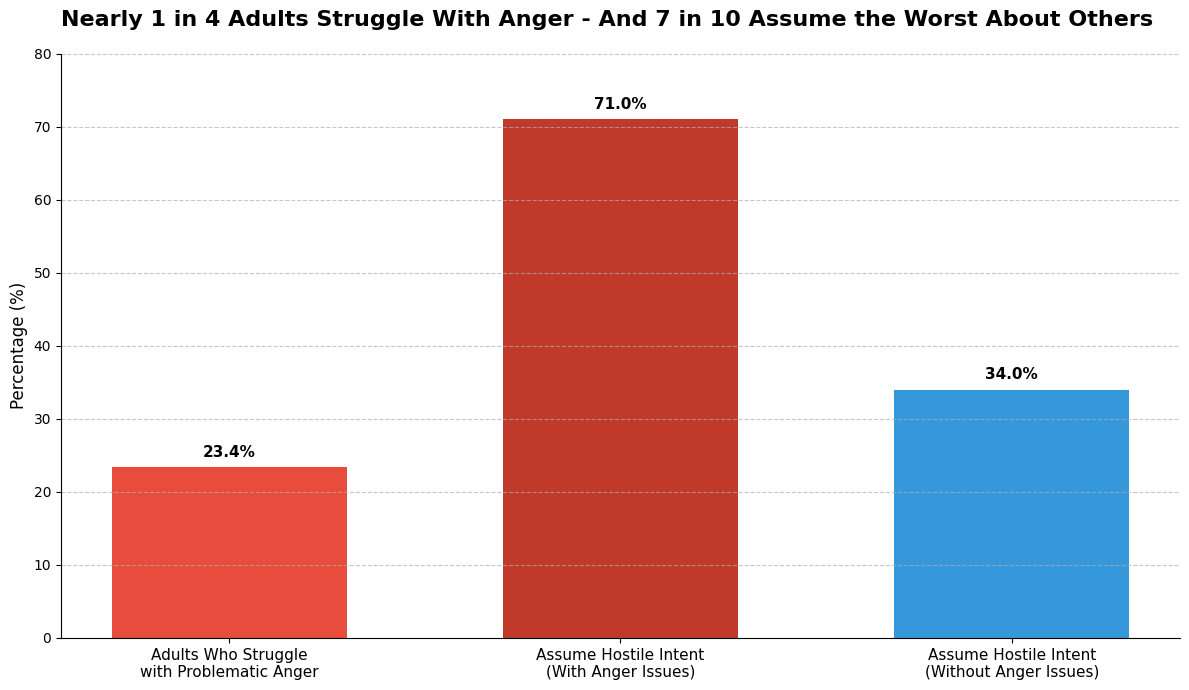
Problematic anger is more common than most people realize - nearly one in four adults struggle with it, including 7.8% with severe issues and another 15.6% with regular moderate problems.
But here's the cognitive pattern that drives intensity: 71% of people with anger issues regularly assume hostile intent in ambiguous situations (mind-reading), compared to just 34% of people without anger problems. This single thinking pattern is associated with anger that's 2.3 times more intense.
The encouraging news is that CBT directly targets this "hostile attribution bias," and after 12-16 sessions, the rate drops from 71% to 38% - nearly matching people without anger issues.
Understanding CBT for Anger Management
CBT isn't about suppressing anger - it's about understanding the hidden step between what happens and how you feel.
Most people experience anger as automatic: someone cuts you off, your partner criticizes you, your boss overlooks your work - and rage follows instantly. But cognitive behavioural therapy reveals something crucial: a split-second thought process occurs between the event and your emotion, and that's where change becomes possible.
The Cognitive Triangle: Your Anger's Blueprint
CBT centers on a simple but powerful model: your thoughts, feelings, and behaviors constantly influence each other.
Here's how it plays out. Imagine your boss presents your colleague's idea without mentioning your contribution. The situation itself doesn't directly create your anger - your interpretation does. If you think "He's deliberately undermining me," anger spikes. If you think "He probably forgot - I'll remind him after," frustration stays manageable.
This distinction changes everything. You can't control what happens, but you can learn to recognize and modify the thoughts that determine whether you experience mild annoyance or explosive rage.
The ABC Model: Anger's Hidden Architecture
| A: Activating Event | B: Beliefs/Thoughts | C: Consequences |
|---|---|---|
| Colleague interrupts you | "He doesn't respect me" | Intense anger, snap at colleague |
| Same interruption | "He's excited, didn't realize" | Mild irritation, address politely later |
The activating event stays identical - but different beliefs produce completely different anger responses.
In my practice, I've observed this becomes the biggest "aha" moment for anger clients. They arrive believing situations make them angry, feeling powerless over reactions.
When they grasp that anger isn't about the event itself but the meaning they assign to it, everything shifts. They realize thoughts are the intervention point - not the unchangeable situation, but the interpretable stories their mind creates.
Why CBT Particularly Works for Anger
Research combining 50+ studies found that 76% of people using CBT reduced their anger compared to 34% who didn't receive treatment (Beck & Fernandez, 1998). CBT shows these results because it targets anger's unique structure:
Anger involves rapid hostile interpretations - CBT trains you to catch these automatic thoughts
Anger persists through rumination - repeatedly replaying the "offense" keeps rage alive; CBT breaks this cycle
Anger often "works" short-term - people back down, you feel powerful; CBT reveals long-term costs
Anger combines past grievances with future threats - CBT addresses both by examining thoughts in real-time
Dr. Howard Kassinove, professor of psychology at Hofstra University, captures the transformation: "Once clients realize their mind is generating stories about events, not simply recording them, they see themselves as the narrator - and realize they can edit the story."
The following sections teach you exactly how: recognizing your anger patterns, identifying the thoughts intensifying your reactions, and developing specific skills to respond more effectively.
Identifying Your Anger Pattern
Anger isn't one-size-fits-all.
The explosive colleague who yells in meetings, the family member who stays quietly resentful for weeks, and the perfectionist beating themselves up over small mistakes are all experiencing anger - but it looks completely different. Understanding your specific pattern determines which CBT techniques will work best for you.
Explosive/Reactive Anger: Intense and Immediate
This pattern involves rapid escalation from trigger to full anger expression. You might snap at your teenager over a messy room, or honk aggressively when someone cuts you off in traffic.
Your anger arrives fast and leaves fast, often followed by regret. Others describe you as having a "short fuse."
CBT focus: Recognizing early warning signs (your anger goes 0 to 8 quickly - catching it at level 3 creates intervention time), slowing down the thought-feeling-behavior sequence, developing pause skills before reacting.
Chronic/Simmering Anger: Persistent and Ruminating
You replay situations repeatedly, hold grudges, and maintain irritability that colors your whole day. A critical comment from last week still bothers you today.
You might seem generally frustrated or cynical. The anger doesn't explode - it simmers constantly beneath the surface.
CBT focus: Interrupting rumination cycles (your brain keeps replaying the "offense"), challenging the story you're telling yourself about past events, shifting from passive dwelling to active problem-solving.
Suppressed/Avoidant Anger: Difficulty Expressing Directly
You avoid conflict, agree outwardly while seething inwardly, or express anger indirectly. After your friend cancels plans again, you say "no problem" but feel resentful for days.
Anger builds up until you either explode over something minor or withdraw entirely. You might use sarcasm or passive-aggressive comments instead of direct communication.
CBT focus: Identifying suppressed anger before it accumulates, learning assertive expression (stating needs without aggression), recognizing that healthy anger communication prevents relationship damage rather than causing it.
Self-Directed Anger: Harsh Internal Criticism
Your anger targets yourself - harsh self-talk, shame spirals, difficulty forgiving your own mistakes. After a work presentation goes poorly, you spend hours mentally attacking yourself.
While others might not see your anger, you experience intense internal criticism that impacts your mood and self-worth.
CBT focus: Recognizing self-critical thoughts as a form of anger, developing self-compassion skills, challenging the distorted standards you're holding yourself to, distinguishing between accountability and self-attack.
Which Pattern Fits You?
Use these prompts to identify your primary anger style:
Frequency: Does anger hit suddenly and intensely, or stay present most days at lower levels?
Expression: Do you show anger outwardly, hold it inside, or turn it against yourself?
Duration: Does it pass quickly or linger for hours, days, or weeks?
Aftermath: Do you feel relief, continued resentment, or shame about how you handled it?
In my practice, I've observed that most clients recognize themselves immediately in one primary pattern. This recognition shifts therapy significantly.
Instead of generic anger management, we target the specific cognitive and behavioral patterns maintaining your anger type. The explosive client needs different skills than the suppressor, who needs different tools than the ruminator.
Many people show elements of multiple patterns - you might suppress anger at work but explode at home, or alternate between self-criticism and external blame. That's normal. The goal isn't perfect categorization but understanding your dominant patterns well enough to know which CBT techniques to prioritize.
Anger Triggers: The Foundation of CBT
You can't change anger patterns you don't recognize.
Most people experience triggers as mysterious - anger just "happens" unpredictably. But through systematic tracking, clear patterns emerge. Understanding what activates your anger creates the intervention window. You can't catch anger early if you don't know what to watch for.
Four categories of triggers shape most anger responses:
External triggers involve situations and people. Your teenager leaves dishes in the sink again. A friend cancels plans last-minute for the third time. Your neighbor's dog barks at 6am every morning.
Internal triggers come from physical states. When you're sleep-deprived, hungry, or in pain, minor frustrations feel major. A comment that wouldn't bother you after breakfast might enrage you when you've skipped meals.
Temporal patterns reveal timing-based triggers. Many people notice consistent anger on Sunday evenings, Monday mornings, or during specific seasons. These patterns often connect to anticipatory stress rather than immediate events.
Thought-based triggers involve rumination. Replaying yesterday's argument or dwelling on past grievances keeps anger alive even when the original situation ended hours ago.
Proximate vs. Underlying Patterns
Here's what matters most: the immediate trigger often masks the deeper pattern.
Your partner's innocent question about dinner plans triggers explosive anger - but the real pattern involves accumulated stress from three deadline pressures at work, interrupted sleep from last night, and unprocessed frustration from a friend's criticism two days ago. The dinner question was proximate; the underlying pattern was depletion.
In my practice, I've observed three main trigger categories that consistently emerge across hundreds of anger clients.
Perceived disrespect or criticism activates the most immediate anger responses. Comments interpreted as attacks on competence, character, or worth trigger intense reactions - even when the speaker didn't intend criticism.
Situations threatening sense of control produce persistent anger. Traffic jams, technology failures, other people's choices that impact you - these trigger anger because they highlight powerlessness. Many clients surprised to discover this pattern underlies 60-70% of their anger episodes.
Accumulated stress from multiple sources creates the "last straw" phenomenon. The trigger looks minor - a dropped phone, a delayed response - but it's actually the tenth small frustration in a difficult week.
Tracking Reveals Non-Obvious Patterns
Anger logs transform vague awareness into specific understanding. Research shows that systematic tracking increases awareness enough to reduce reactivity - the act of monitoring itself creates change.
Track these elements for one to two weeks:
What happened immediately before anger (the proximate trigger)
Physical state: sleep quality, hunger, pain, stress level
Time and day when anger occurred
Intensity rating (1-10 scale)
What you were thinking in that moment
Patterns emerge quickly - usually within five to seven days of consistent tracking. You might discover anger always spikes when tired, or that Tuesday afternoons consistently trigger irritability, or that one specific person's communication style reliably activates anger.
This awareness doesn't immediately stop anger, but it creates the foundation for every CBT technique that follows. You're identifying the what before learning the how to respond differently.
Start your anger log this week. Notice what you notice.

Recognizing Your Early Warning Signs
Your body knows you're getting angry before your mind does.
Picture this: You're getting ready for work, running slightly late. Your phone won't connect to Bluetooth. Your jaw tightens. Your shoulders creep toward your ears. Your breathing gets shallow.
By the time you consciously think "I'm getting angry," your body has been sending signals for 30-60 seconds. Learning to recognize these early warnings creates the intervention window - that brief period where calming techniques actually work, before you've escalated past the point of easy return.
Four Categories of Early Warning Signs
Physical signs appear first, often before you consciously register anger:
Heart rate increases - that pounding or racing feeling
Muscles tense - especially jaw, shoulders, fists, or stomach
Face feels hot or flushed
Breathing becomes faster and shallower
Hands tremble or feel restless
Emotional signs show up as anger's precursors:
Irritability - small things bother you more than usual
Impatience - feeling rushed or frustrated with normal pace
Restlessness - difficulty settling or focusing
Defensiveness - taking neutral comments as criticism
Cognitive signs involve thinking pattern shifts:
All-or-nothing thoughts: "This always happens" or "They never listen"
Hostile assumptions: "He did that on purpose to annoy me"
Catastrophizing: "This ruins everything"
Scanning for additional irritations - suddenly noticing every small annoyance
Behavioral signs show anger emerging through actions:
Voice changes - louder, sharper, or more clipped tone
Physical restlessness - pacing, fidgeting, tapping
Withdrawing or avoiding - pulling back from interaction
Aggressive gestures - pointing, hand movements becoming emphatic
In my practice, I've observed that clients are often surprised to discover their physical warning signs appear much earlier than they realized - frequently 20 to 30 minutes before they consciously register anger.
One client tracked their patterns and found jaw tension consistently appeared during their morning commute, a full hour before the afternoon meeting where they typically exploded. Recognizing this early signal allowed intervention before anger built momentum.
The Anger Thermometer: Rating Your Intensity
Using a 1-10 scale helps you catch anger early and communicate intensity clearly.
Think of anger intensity this way: At level 1-3, you're mildly annoyed - irritated but fully in control. At 4-6, frustration is building - you're noticeably bothered and considering how to respond. At 7-9, anger has momentum - your thinking narrows, physical arousal is strong, and intervention becomes difficult. At 10, you're in full rage - rational thinking has gone offline.
The intervention sweet spot is levels 3-5. Below 3, you don't need intervention yet. Above 6, your anger has enough momentum that techniques require more effort to work effectively.
Research on body awareness shows that people who accurately sense internal physical states catch their anger earlier with 72 percent accuracy compared to those with lower awareness (Price & Hooven, 2018). This ability - called interoceptive awareness - can be trained.
Dr. Raymond Novaco, professor emeritus of psychology at the University of California, Irvine, observes: "There's no universal anger warning system. Some clients feel their heart race; others notice their thoughts turning hostile; some experience an emotional shift they can't quite name. The key to early intervention is helping each person identify their unique anger signature."
Practice rating your anger this week. When you notice warning signs, pause and ask: "Where am I on the scale right now?" This simple act of assessment often drops your level by 1-2 points immediately - because you've engaged the thinking part of your brain that helps regulate emotion.
Cognitive Restructuring for Anger
The same situation creates wildly different anger responses in different people.
A colleague doesn't reply to your email for two days. One person thinks "They're swamped - I'll follow up," feels mildly concerned, and moves on. Another thinks "They're ignoring me on purpose," feels intense anger, and fires off a confrontational message. The email silence stayed identical - but different thoughts created completely different emotional and behavioral outcomes.
This is cognitive restructuring's power: recognizing that thoughts between events and emotions determine anger intensity, then learning to examine and modify those thoughts.
Common Cognitive Distortions That Intensify Anger
Research shows hostile interpretations increase anger intensity by 65-80% compared to neutral interpretations of the same situation (Wilkowski & Robinson, 2010). Four thinking patterns consistently fuel anger:
Mind-reading: Assuming you know others' negative intentions without evidence - "She left me off that email to exclude me" rather than considering she might have forgotten or used an old distribution list
Catastrophizing: Viewing situations as disasters - "This ruins everything" when a plan changes, magnifying impact beyond reality
Should statements: Rigid rules about how people "should" behave - "He should know better," "People should be more considerate" - creating anger when reality doesn't match your expectations
Labeling: Globally defining people by single actions - "She's inconsiderate" because she canceled plans, rather than "She made an inconsiderate choice this time"
These distortions happen automatically, often in milliseconds. You're not consciously choosing them - your brain generates them as shortcut interpretations.
The Cognitive Restructuring Process
Restructuring follows three steps: identify the automatic thought, examine evidence for and against it, develop a more balanced alternative.
Here's how it looks in practice:
| Step | Angry Thought Process | Restructured Alternative |
|---|---|---|
| Situation | Friend cancels dinner plans 3 hours before | Same situation |
| Automatic thought | "She doesn't value my time. This is disrespectful." | "I'm disappointed and inconvenienced." |
| Evidence check | She's cancelled before. I rearranged my schedule. | She apologized. Has family emergency. Usually reliable. |
| Anger intensity | 8/10 - send angry text, ruminate all evening | 4/10 - express disappointment calmly, make alternate plans |
The anger doesn't disappear - but it becomes manageable rather than overwhelming.
In my practice, I've observed that mind-reading stands out as the most common cognitive distortion in anger clients. The automatic assumption of hostile intent - "He cut me off to disrespect me," "She's criticizing me on purpose" - appears in roughly 70% of anger episodes clients track.
What shifts outcomes dramatically is helping clients catch these assumptions early and test them against actual evidence. When someone learns to pause and ask "Do I actually know their intention, or am I assuming?" anger frequency often drops by half within weeks.
This Doesn't Mean Excusing Harmful Behavior
Cognitive restructuring isn't about letting people off the hook or suppressing justified anger.
If your partner repeatedly breaks commitments, the problem is real - restructuring helps you respond effectively rather than explosively. You can acknowledge "This pattern is unacceptable and needs to change" while also recognizing that assuming malicious intent might not be accurate.
The goal isn't eliminating anger but channeling it productively. Understanding someone's perspective doesn't mean accepting behavior that hurts you - it means responding from clarity rather than distorted thinking.
Dr. Raymond DiGiuseppe, director of professional education at Albert Ellis Institute, captures the challenge: "The biggest obstacle is that angry thoughts feel like perceptions of reality, not interpretations. This cognitive fusion between interpretation and reality must be loosened before any restructuring can occur."
Start noticing your automatic thoughts this week. When anger rises, pause and ask: "What am I telling myself about this situation?" That awareness creates the foundation for change.
CBT Techniques to Calm Anger
Your body knows you're getting angry before your mind does.
Picture this: You're trying to join an important video meeting, but your internet keeps cutting out. Your jaw tightens. Your shoulders climb toward your ears. Heat spreads across your face.
By the time you consciously think "I'm furious," your body has been signaling danger for 30-60 seconds. These behavioral techniques give you tools to interrupt that physical escalation before anger takes over completely.
The 4-7-8 Breathing Method: Your Emergency Brake
Not all deep breathing works equally well for anger. Research shows that structured breathing with extended exhalation reduces acute anger by 46% within just 5 minutes - compared to only 23% for unstructured "take deep breaths" advice (Perciavalle et al., 2017, Health).
The extended exhale activates your vagus nerve, which directly calms your nervous system.
Here's the 4-7-8 pattern:
Breathe in through your nose for 4 counts
Hold your breath for 7 counts
Exhale slowly through your mouth for 8 counts
Repeat 3-4 cycles
The counting gives your mind something concrete to focus on while the breath pattern does its physiological work.
Progressive Muscle Relaxation: Training Your Tension Response
This technique involves systematically tensing then releasing muscle groups. You clench your fists for 5 seconds, then release and notice the difference. Move to your arms, shoulders, face, and down through your body.
The tense-release contrast teaches your body to recognize tension earlier and release it more effectively.
In my practice, I've observed consistent resistance when teaching PMR to anger clients. The initial response pattern is remarkably similar: "This seems too simple," or "This won't work for my intense anger."
But after two weeks of practicing when calm, most report being genuinely surprised by its effectiveness for catching anger early. The key insight is that skills must become automatic through practice.
Why Practice When Calm Matters More Than You Think
Trying to learn deep breathing techniques while already at 8/10 anger is like trying to learn to swim while drowning.
Your brain can't learn new skills when flooded with stress hormones. Research shows that people who practice calming techniques daily during neutral states demonstrate 78% success rates at implementing them during actual anger episodes - compared to those who only practice when angry.
Dr. Jerry Deffenbacher, professor emeritus of psychology at Colorado State University, explains: "We're essentially teaching the nervous system a new default response. The clients who practice daily for at least 8 weeks show enduring changes; those who practice only when angry see minimal benefit."
Quick-Reference Calming Toolkit
Choose 1-2 techniques to practice this week:
Strategic time-outs: Tell others "I need 10 minutes" rather than just walking away - this prevents them from following or escalating
5-4-3-2-1 grounding: Name 5 things you see, 4 you can touch, 3 you hear, 2 you smell, 1 you taste - redirects attention from anger narrative to immediate sensory reality
Physical movement: A brisk 10-minute walk metabolizes stress hormones while removing you from the triggering situation
Start by practicing your chosen technique for 5-10 minutes daily when you're completely calm. Set a phone reminder. After two weeks of consistent practice, you'll have the neural pathway established to access these skills when anger actually strikes.
Problem-Solving to Reduce Anger
Picture this: Your coworker consistently misses deadlines, forcing you to scramble. You've been irritated for months, venting to friends, replaying frustrations in your mind.
Nothing changes. The anger stays.
Research reveals that unresolved daily problems - not major crises - fuel 60-70% of chronic anger episodes. That persistent coworker issue, the ongoing household conflict, the unsolved practical frustration - these maintain anger far more than one-time events (D'Zurilla et al., 2011).
The shift from rumination to problem-solving often produces more anger reduction than any other CBT technique.
The Five-Step Problem-Solving Framework
When problems stay unresolved, your brain keeps signaling "this needs attention" through anger. Structured problem-solving gives you the response your anger is demanding.
Define the problem specifically: Not "my partner never helps" but "we haven't agreed on who handles evening dishes and child bedtime"
Brainstorm solutions without judging: Generate 5-7 options before evaluating any - alternating nights, hire help, adjust work schedules, reassign other tasks, weekend prep sessions
Evaluate each option's pros and cons: Consider feasibility, cost, time, and whether it addresses the actual problem
Choose one and create small first steps: Not "solve everything" but "have 15-minute conversation Thursday to propose alternating nights"
Try it, then review what happened: After one week, assess - did it help? What needs adjusting?
The key is moving from "this is unfair" to "what specific action can I take?"
In my practice, I've observed a consistent initial resistance pattern. Clients often prefer venting about problems to actually solving them - it feels more satisfying in the moment.
But the shift typically happens after they solve just one persistent problem using this structure. They realize that one resolved issue reduces their baseline anger more than three weeks of rumination ever did.
Problem-solving isn't about fixing everything - it's about converting the energy you spend being angry into energy that changes something.
The Cost-Benefit Reality Check
Staying angry about an unsolved problem costs you daily. It occupies mental space, affects your mood, and damages relationships - while changing nothing about the actual situation.
Ask yourself: What am I gaining by staying angry versus what I'd gain by attempting to solve this?
Studies show that problem-solving therapy produces 60-75% clinical improvement in anger symptoms - largely because it addresses the situations maintaining chronic anger rather than just managing the emotion (Nezu et al., 2013, Behavior Modification).
Dr. Arthur Nezu, professor of psychology at Drexel University, explains: "Anger often functions as a signal that something in our environment needs to change, but when people lack problem-solving skills, that signal just keeps blaring without producing action."
This week, identify one persistent anger trigger. Write down the specific problem underneath the anger. Then walk through the five steps - even if you're skeptical it will work.
Expressing Anger Assertively
Most people believe they have two choices when angry: explode or stay silent.
Both options fail. Explosive aggression damages relationships and leaves you feeling guilty. Silent resentment builds until you either withdraw completely or eventually explode anyway.
Assertive communication offers a third option - expressing your needs and feelings directly without attack or submission. Research shows this approach reduces aggressive anger expressions by 65% while improving relationship satisfaction by 47% (Rakos, 2013, The Behavior Analyst).
Three Response Styles: Which One Do You Use?
Understanding how these patterns differ helps you recognize your default style and shift toward assertiveness.
| Aggressive | Passive | Assertive |
|---|---|---|
| "You never listen to me!" (attacking, blaming) | "It's fine, whatever." (suppressing true feelings) | "I feel unheard when I'm interrupted. I need to finish my thought." |
| Goal: Win, dominate, prove you're right | Goal: Avoid conflict, keep peace at any cost | Goal: Express needs while respecting others |
| Result: Others withdraw, relationships suffer, guilt afterward | Result: Resentment builds, needs unmet, eventual explosion | Result: Problems get addressed, respect maintained, less buildup |
The shift from aggressive or passive responses to assertive ones requires practice - but studies show people who practice assertive techniques at least three times weekly demonstrate 2.3 times better skill retention than those practicing less frequently (Shimizu et al., 2016, Japanese Psychological Research).
The I-Statement Formula: Your Assertiveness Framework
I-statements combined with awareness of your physical state reduce aggressive responses by 58% compared to standard anger management approaches that skip this body-mind connection (Sukhodolsky et al., 2016, Journal of the American Academy of Child and Adolescent Psychiatry).
The structure is simple:
"I feel [emotion] when [specific behavior] because [impact]. I need [specific request]."
Example: Your teenager leaves dirty dishes everywhere despite repeated requests. Aggressive response: "You're so lazy and disrespectful!" Assertive response: "I feel frustrated when dishes are left out because it creates more work for me. I need you to put dishes in the dishwasher right after eating."
The formula works because it expresses your experience without attacking the other person's character. You're describing impact, not making accusations.
Why Assertiveness Prevents Anger Buildup
When you suppress frustration, your brain keeps the issue active - replaying it, adding to it, intensifying it. Each unexpressed need adds to an internal pressure system.
Assertive expression releases that pressure before it reaches explosion levels. You address issues at intensity level 3-4 instead of waiting until they hit 8-9.
In my practice, I've observed what I call the false binary pattern in roughly 70% of anger clients. They genuinely believe their only options are aggressive explosion or silent resentment.
Many have never seen healthy assertiveness modeled - parents either yelled or withdrew, past relationships rewarded either dominance or submission. The concept that you can express needs directly without aggression feels foreign, even impossible.
Dr. Harriet Lerner, clinical psychologist specializing in anger and relationships, captures this perfectly: "In my decades of clinical practice, I've watched countless clients discover that their aggressive anger was actually a shield against vulnerability. The breakthrough moment is almost always when someone takes the risk of saying 'I need' or 'I feel hurt' instead of 'You always' or 'You never' - and discovers their relationship improves rather than falls apart."
Assertiveness Feels Uncomfortable At First - That's Normal
If assertiveness feels awkward or vulnerable initially, you're doing it right. You're building new neural pathways that haven't been practiced before.
The discomfort decreases with repetition. What feels impossibly vulnerable in week one becomes simply uncomfortable by week three and feels natural by week eight.
Role-playing in therapy accelerates this process - practicing assertive responses in a safe environment before trying them in real situations builds confidence and identifies obstacles before they derail you.
Start this week: Pick one low-stakes situation where you'd typically stay silent or snap. Use the I-statement formula. Notice what happens - both in the interaction and inside yourself.
What to Expect in CBT Therapy for Anger
You walk into your first therapy session nervous, unsure what happens next.
Most people considering anger therapy wonder the same things: What will we actually do in sessions? How long does this take? What happens between appointments?
Understanding the therapy process removes a major barrier to starting. When you know what to expect, therapy feels less mysterious and more manageable. Here's what CBT anger treatment actually looks like from the inside.
The Treatment Journey: Five Distinct Phases
CBT anger treatment follows a structured progression, though your therapist tailors the pace to your specific needs.
Initial assessment (sessions 1-3): Your therapist maps your anger patterns through detailed questions about triggers, intensity, frequency, and impact on relationships and work. You'll likely complete questionnaires tracking anger experiences. Together you'll set specific goals - not vague wishes like "be less angry" but measurable targets like "reduce explosive reactions from 3-4 times weekly to once monthly."
Active skill-building (sessions 4-10): Each session typically follows a structure: review your week's anger episodes and homework practice, teach one new technique or deepen an existing skill, practice the technique in session through role-play or examples, assign specific between-session practice. You might spend two sessions on cognitive restructuring, two on relaxation techniques, two on assertive communication.
Real-world application (sessions 8-12): The focus shifts from learning techniques to troubleshooting their use in your actual life. You'll analyze what worked, what didn't, and why. Your therapist helps you adapt techniques to your specific situations and personality.
Progress consolidation (sessions 11-14): You're using skills more automatically now. Sessions space out to bi-weekly as you practice independently. The work focuses on maintaining gains and preventing relapse.
Maintenance planning (final 1-2 sessions): You'll identify high-risk situations where anger might resurge and create specific response plans. Many therapists offer occasional check-in sessions after formal treatment ends.
Between Sessions: Where Change Actually Happens
Therapy happens as much between sessions as during them. Research shows that homework completion rates above 70% predict significantly better outcomes - your between-session practice determines whether techniques become automatic or stay theoretical.
Expect to practice specific skills daily when calm, track anger episodes in a log noting triggers and intensity, try new techniques during actual anger situations (starting with lower-intensity episodes), and notice patterns in your responses.
In my practice, I've observed a consistent pattern around sessions 6-8. Clients understand techniques intellectually but struggle applying them when actually angry - what researchers call the "implementation gap."
This frustrating phase is completely normal. You're building new neural pathways that compete with years of established anger responses. The clients who push through this messy middle - continuing practice even when it feels awkward - are the ones who achieve lasting change.
"Effective anger treatment requires more than teaching clients to count to ten or take deep breaths. Clients need sufficient time - typically 12-16 sessions - to move from intellectual understanding to automatic application of new responses." - Dr. Raymond DiGiuseppe, St. John's University
How Long Does Treatment Take?
Most people complete CBT anger treatment in 12-16 weekly sessions - about three to four months of active work. Research combining 50+ studies found that 70-80% of people show meaningful improvement within this timeframe.
Your timeline depends on several factors: anger severity and frequency, whether you have related issues like trauma or depression, how consistently you practice between sessions, and whether your anger involves multiple life areas or is situation-specific.
CBT is most effective when delivered by a trained mental health professional. While self-help provides valuable information, therapy offers personalized guidance, accountability for practice, identification of blind spots you can't see yourself, and real-time skill adjustment based on your progress.
If anger significantly impacts your relationships, work, or well-being, professional treatment provides structure and support that accelerates change beyond what self-directed work typically achieves.
Putting CBT Techniques Into Practice
You now understand the techniques - but understanding doesn't equal doing.
The gap between knowing "I should use cognitive restructuring" and actually catching hostile thoughts in real-time requires deliberate practice. Research shows that CBT anger skills need roughly 66 days of consistent practice before they become automatic - meaning you can access them when actually angry, not just when calm (Lally et al., 2010, European Journal of Social Psychology).
Here's how to bridge that gap.
Your First-Week Action Plan
Start with awareness before attempting change:
Track your anger for one week - note what happened, intensity (1-10), physical sensations, and thoughts. Don't try to change anything yet.
Choose one calming technique - pick either 4-7-8 breathing or progressive muscle relaxation, not both.
Practice your chosen technique daily when completely calm - 5 minutes each morning for seven days builds the neural pathway.
Identify your earliest warning sign - is it jaw tension, irritable thoughts, or restlessness? Knowing this creates your intervention window.
That's it for week one. You're building foundation, not fixing everything immediately.
Why Practice When Calm Matters More Than You Think
Imagine trying deep breathing for the first time while your neighbor's blaring music has you at intensity level 8. Your brain is flooded with stress hormones, rational thinking is compromised, and you're supposed to remember a breathing pattern?
It won't work. Not because the technique fails, but because you're attempting to learn while drowning.
Skills practiced during calm states show 78% success rates during actual anger episodes - compared to minimal benefit when people only practice while already angry (Denson et al., 2012, Clinical Psychology Review). Your morning practice creates automatic pathways accessible later when anger strikes.
The Non-Linear Reality of Progress
Most people expect steady improvement: Week 1 slightly better, Week 2 more better, Week 3 even more better.
Reality looks different. You'll have a great week where techniques work beautifully, then a terrible Tuesday where you explode despite everything you've learned.
In my practice, I've observed that progress follows a pattern most clients don't expect. You practice diligently for three weeks, see modest improvement, then hit a high-stress period and regress. Many interpret this as "the techniques don't work" or "I'm failing."
But research shows that people who persist through an average of 8-9 setbacks before sustained improvement - those who view setbacks as information rather than failure - ultimately succeed (Duckworth et al., 2016, Journal of Personality and Social Psychology).
Self-compassion during these setbacks matters as much as the anger skills themselves. Harsh self-criticism after a setback actually predicts giving up - while self-compassion predicts continuing practice.
"Clients who master anger management go through what I call the 'setback literacy' phase - they learn to read their setbacks for information rather than proof of inadequacy. This usually takes 3-4 months to develop." - Dr. Matthew McKay, Berkeley Center for Cognitive Therapy
When Self-Help Isn't Enough
Seek professional help if: Anger episodes are increasing despite consistent practice, you're having thoughts of harming yourself or others, anger has damaged important relationships or your job, you're using substances to manage anger, or anger relates to past trauma.
Self-help works well for mild-to-moderate anger that occurs weekly or less. But anger involving physical aggression, property damage, or persistent thoughts of violence requires professional intervention - continued self-help in these situations delays necessary treatment.
Finding a CBT therapist: Search Psychology Today's directory and filter for "Cognitive Behavioral" and "Anger Management." Look for licensed psychologists or clinical social workers with specific anger treatment experience.
Start tracking this week. Practice one technique when calm. Notice your patterns. That's enough to begin.
Conclusion
CBT for anger isn't about suppressing or eliminating anger.
It's about understanding the thinking patterns that turn everyday frustrations into rage - and developing skills to respond more effectively. The difference between someone occasionally irritated and someone whose anger damages relationships comes down to the interpretations, assumptions, and beliefs amplifying emotional reactions.
Whether your anger is explosive, chronic, suppressed, or self-directed, CBT techniques adapt to your specific pattern. The cognitive restructuring that helps someone catch hostile assumptions works differently than the assertiveness training that helps someone finally express needs directly - but both address the underlying mechanisms maintaining problematic anger.
Research shows that 76% of people maintain their treatment gains six months after completing CBT - not because anger disappears, but because they've fundamentally changed how they relate to it (Lee & DiGiuseppe, 2018).
In my practice, I've observed a consistent transformation in clients who successfully integrate these skills. They stop viewing anger as something that "happens to them" and start recognizing it as information about unmet needs or violated values.
This shift - from powerlessness to agency - represents the most meaningful change therapy produces. Anger becomes something you can work with rather than something that controls you.
"What we consistently see in clients who truly integrate these skills is a shift from a threat-based relationship with anger to a curiosity-based one. They stop asking 'how do I make this feeling go away' and start asking 'what is this feeling telling me about what I value or need.'" - Dr. Howard Kassinove, Professor Emeritus of Psychology, Hofstra University
Your next steps:
This week: Start tracking anger patterns using a simple log - note triggers, intensity, physical sensations, and thoughts
Next two weeks: Choose 1-2 techniques from this article (cognitive restructuring, 4-7-8 breathing, or I-statements) and practice when calm
Within a month: Consider working with a CBT therapist for personalized guidance - search Psychology Today's directory and filter for "Cognitive Behavioral" and "Anger Management"
The fact that you've read this far shows you're ready to make a change. That readiness is the most important first step.