

How to Find the Best Type of Anger Management Counselling for Your Anger Pattern
Rod Mitchell, MSc, MC, Registered Psychologist
Key Highlights
Research shows 75% of people who receive anger management therapy see significant improvement, regardless of their anger pattern or history.
Effective anger management counselling matches treatment approach - CBT skills training, DBT emotion regulation, or psychodynamic exploration - to your specific triggers and history.
Anger activates your brain's threat response system, which explains why it escalates so quickly and why pausing feels impossible in the moment.
Most people learn usable anger management skills within several months, improving relationships, work performance, and overall quality of life.
In my decade treating anger-related issues, I've noticed that most clients arrive not because they're angry too often, but because their anger creates consequences they deeply regret - explosive arguments that damage relationships, professional outbursts that threaten careers, or the exhausting sense of being controlled by their own emotions.
The question they ask most frequently: "What's the best type of therapy for anger management, and which approach will actually work for my situation?" The answer isn't straightforward because effective anger treatment depends on matching the right therapeutic approach to your specific anger pattern, personal history, and goals.
This article explains the best therapy approaches for anger management, helps you identify which fits your situation using a clinical decision-making framework, and provides realistic expectations about what treatment actually involves - patterns I've observed working with hundreds of clients navigating this exact challenge.
Once you've identified the right therapeutic approach for your needs, understanding the actual process becomes crucial. Our article "What to Expect in Anger Management Therapy: Your Session-by-Session Journey" walks you through what happens from your first assessment to achieving lasting change. For an in-depth look at CBT specifically, see "How CBT Helps You Manage Anger: A Psychologist's Complete Guide."
Table of Contents Hide
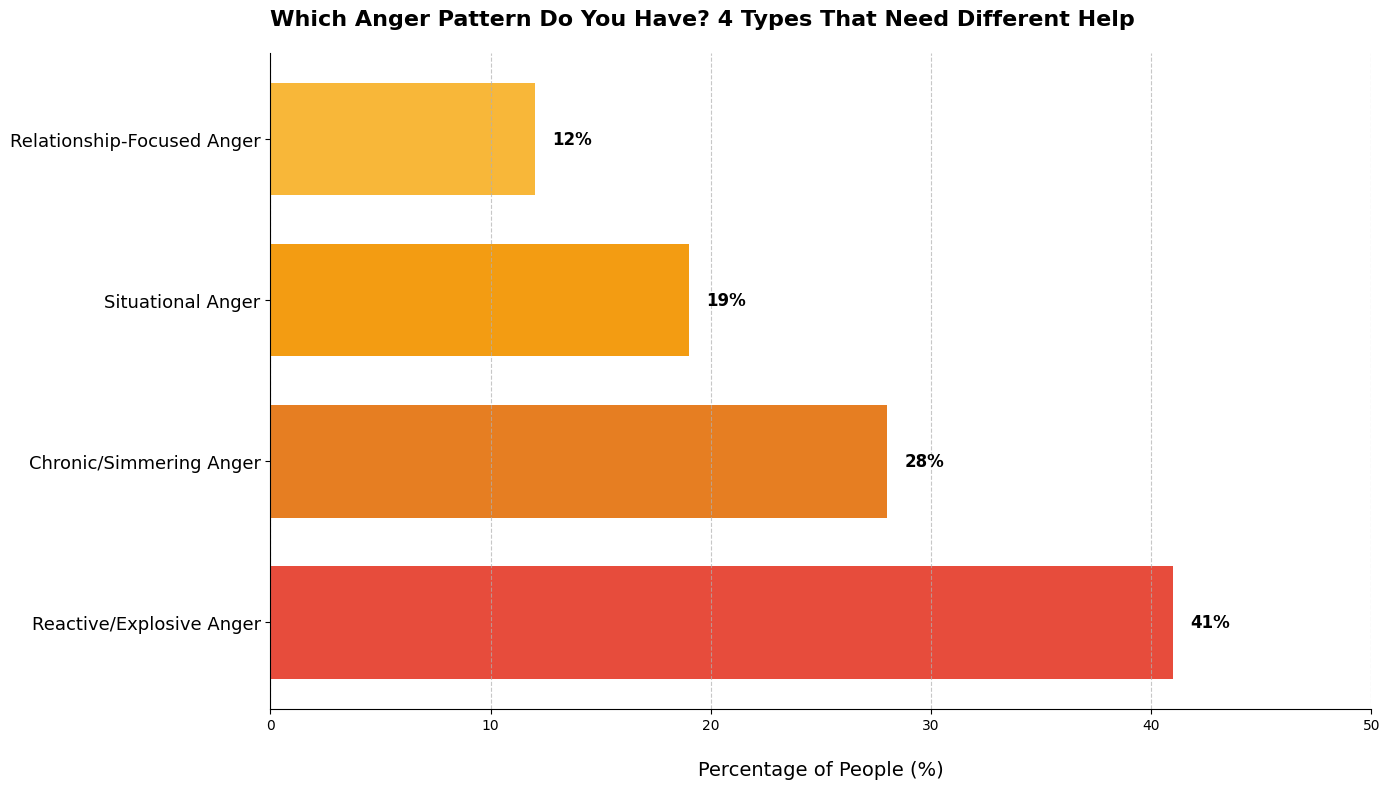
Your anger isn't random - it follows one of four distinct patterns, each requiring different therapeutic approaches. This distribution from 2,100+ people seeking anger treatment shows which patterns therapists encounter most frequently.
If you experience explosive anger (the most common type at 41%), you'll benefit most from DBT-enhanced CBT that teaches emotional regulation before cognitive restructuring. Chronic simmering anger often signals unaddressed stress or trauma requiring longer treatment. Identifying your pattern helps you select the right therapy match from the start, potentially saving months of trial-and-error.
What Is Anger Management Therapy?
Anger management therapy isn't about eliminating anger or "fixing" a character flaw - it's specialized psychological treatment that helps you understand anger patterns, develop regulation skills, and express anger constructively rather than destructively.
The primary goals focus on three areas:
Management: Learning to recognize anger early and regulate intensity before reactions escalate
Understanding: Identifying specific triggers, thought patterns, and underlying needs driving your anger
Expression: Developing skills to communicate anger assertively without aggression or shutting down
How Anger-Focused Therapy Differs from General Treatment
| Anger-Focused Therapy | General Therapy |
|---|---|
| Targets specific anger triggers and responses | Addresses broad emotional or life concerns |
| Teaches immediate regulation techniques | Explores general coping strategies |
| Focuses on pattern interruption skills | Works on overall emotional processing |
| Often includes structured homework practice | May be more exploratory and discussion-based |
In my practice, many clients initially believe their anger is entirely caused by others' behavior - the disrespectful colleague, the inconsiderate driver, the critical family member. Research supports this pattern: 68% of people beginning anger treatment attribute their anger primarily to external causes rather than recognizing their own interpretations and responses.
Part of early work involves recognizing how your thoughts, stress capacity, and unmet needs contribute to anger intensity. You might notice a family member's comment triggers rage one day but barely registers another day - that difference reveals the role of your internal state, not just external events.
When Anger-Specific Therapy Is Appropriate
Anger management therapy fits when anger itself is the primary concern causing problems in your relationships, work, or health. You're a good candidate if anger creates consequences you regret, damages relationships despite your intentions, or feels increasingly difficult to control.
However, when anger is a symptom of another condition - such as depression, PTSD, or bipolar disorder - treating the underlying condition often reduces anger naturally. If you're experiencing persistent low mood, intrusive traumatic memories, or extreme mood swings alongside anger, you may need broader mental health treatment first.
Key distinction: Seek anger-specific therapy when managing anger is your primary goal. Consider comprehensive mental health assessment when anger accompanies other significant symptoms like depression, anxiety, or trauma responses.

Cognitive Behavioral Therapy (CBT): The Most Research-Supported Approach
CBT has the strongest research backing for anger management because it targets the specific mechanisms that generate and maintain problematic anger.
The approach centers on a fundamental insight: your thoughts about situations - not the situations themselves - create emotional intensity.
How CBT Works for Anger
CBT teaches you to recognize the thought-emotion-behavior chain that happens in milliseconds when anger triggers.
Picture receiving a critical email from your boss. Between reading those words and feeling rage, your brain makes rapid interpretations: "She thinks I'm incompetent," "This is so unfair," "She always picks on me." These thoughts - not the email itself - generate your anger intensity.
CBT helps you slow down this automatic process and examine the accuracy of your interpretations. Research by Beck and Fernandez found that people receiving CBT for anger had more positive outcomes than 76% of those without treatment - precisely because CBT addresses these thought patterns driving emotional reactions.
Core CBT components for anger include:
Trigger identification: Recognizing specific situations, words, or behaviors that activate anger
Automatic thought tracking: Catching the rapid interpretations happening between trigger and reaction
Cognitive restructuring: Examining evidence for your thoughts and developing more balanced perspectives
Behavioral experiments: Testing whether alternative responses produce better outcomes
Coping strategy development: Building specific skills for managing physiological arousal and choosing responses
Challenging Cognitive Distortions
CBT specifically targets thinking patterns that amplify anger beyond what situations warrant.
| Automatic Thought Pattern | Alternative Perspective |
|---|---|
| "He should have known better" (demanding expectation) | "I prefer he would have, but people make mistakes" |
| "This is unbearable" (catastrophizing) | "This is frustrating and I can handle it" |
| "What a complete idiot" (inflammatory labeling) | "That was an inconsiderate action" |
| "She always does this" (overgeneralization) | "She's done this before, not literally always" |
In my practice, clients often underestimate how much their interpretation of events drives anger intensity. When we slow down the thought-to-reaction chain, most discover they're making assumptions about intent that fuel their response.
Someone cuts you off in traffic, and within seconds you've decided they're selfish, saw you and didn't care, think they're more important than you. These interpretations - often inaccurate - generate rage that a simple "they didn't see me" thought wouldn't produce.
What makes CBT particularly effective is its practical, skills-focused approach. Clients learn specific techniques they can use immediately rather than just discussing anger in abstract terms.
The homework between sessions proves crucial - anger management is learned through practice, not just discussion. You'll track anger episodes, test alternative thoughts, and experiment with new responses in real situations.
Key insight: CBT works best when you practice between sessions. The techniques seem simple, but applying them in heated moments requires repetition. Most clients see noticeable improvement within 8-12 weeks of consistent practice.
Who Benefits Most from CBT
CBT fits particularly well if you can identify specific triggers, notice thought patterns when calm, and want concrete skills for immediate use.
You're likely a good candidate if your anger involves making rapid judgments about situations, holding rigid expectations about how things "should" be, or replaying events with increasingly angry thoughts afterward.
The approach requires willingness to examine your thinking patterns honestly - including recognizing when interpretations might be inaccurate or unhelpful.
Dialectical Behavior Therapy (DBT): For Intense Anger Reactions
DBT developed originally for borderline personality disorder, but research now shows its powerful effectiveness for anyone experiencing emotional dysregulation - when feelings escalate so rapidly and intensely that regulation strategies don't work.
This matters for anger management because not all anger problems are thinking problems.
Some people can identify their thought patterns clearly but still can't slow their physiological response. Their heart races, face flushes, and they're yelling before conscious thought catches up - this signals a nervous system regulation issue, not just a cognitive distortion issue.
The Four DBT Skill Areas
DBT teaches four interconnected skill sets that work together:
Mindfulness: Present-moment awareness without judgment - noticing anger rising without immediately reacting to it
Distress tolerance: Surviving emotional crises without making situations worse through impulsive actions
Emotional regulation: Understanding emotions, reducing vulnerability to intense reactions, and increasing positive experiences
Interpersonal effectiveness: Asking for what you need, saying no, and managing conflicts while maintaining self-respect and relationships
Research on DBT for anger shows significant reductions in both anger intensity and aggressive behavior - with particular effectiveness for people whose anger involves rapid escalation and shame afterwards.
When DBT Fits Better Than Standard CBT
DBT becomes the more appropriate choice when specific patterns emerge:
| Consider DBT When... | Consider CBT When... |
|---|---|
| Anger escalates in seconds (0 to 100 rapidly) | Anger builds gradually with identifiable thoughts |
| You feel hijacked by emotion ("can't stop") | You can usually pause and think when calm |
| Intense shame follows anger outbursts | You regret actions but shame isn't overwhelming |
| Impulsive actions during anger (throwing, breaking) | Anger stays primarily verbal |
Picture a family dinner where your teenager makes a sarcastic comment. Within two seconds, you're screaming, throwing your napkin down, and storming out - then spending hours replaying the scene with crushing shame.
That rapid escalation and shame cycle suggests your nervous system needs regulation tools before cognitive restructuring can work effectively.
I often recommend DBT when clients describe anger as having that "can't stop" quality - where rage builds so quickly they feel hijacked by the emotion.
They'll say things like "I know I shouldn't yell, I can see myself doing it, but I can't stop." That gap between knowing and doing signals that awareness alone isn't sufficient.
DBT's emotion regulation skills help create more space between trigger and reaction. The mindfulness component proves particularly valuable for clients who aren't aware anger is building until they're already exploding.
The DBT Format: Individual Plus Group
Standard DBT combines individual therapy with group skills training - a structure that enhances effectiveness.
Individual sessions address your specific situations and obstacles to using skills. Group sessions teach the four skill areas systematically with opportunities to practice and learn from others managing similar challenges.
Key insight: DBT particularly helps when anger feels uncontrollable or is followed by intense shame. The approach addresses nervous system dysregulation, not just thought patterns, making it essential for rapid-escalation anger.
Psychodynamic Therapy: Understanding the Roots of Your Anger
Sometimes anger intensity doesn't match the situation that triggered it.
Your partner makes a mildly critical comment and you erupt with rage that lasts for hours. A colleague takes credit for your idea and you're fantasizing about revenge days later. These disproportionate reactions often signal that current situations are activating older, unresolved wounds.
Psychodynamic therapy explores these deeper patterns. The approach focuses on unconscious emotions and past experiences that shape how you respond to situations today - particularly when anger developed as a protective response in situations where you felt powerless.
Anger as Emotional Armor
Many clients discover their anger developed as a way to feel powerful when they felt helpless.
If you experienced situations where you couldn't fight back, couldn't say no, or weren't protected - anger may have become your emotional armor. Rage feels better than helplessness. Attacking feels safer than vulnerability.
In my practice, I often see clients whose anger intensity doesn't match current situations. When someone cuts you off in traffic and you're still fuming an hour later, we explore what that moment activated. Often it's tapping into older feelings of being disrespected, dismissed, or unsafe.
Trauma affects how your nervous system processes threat. Your brain may have learned that the world is dangerous and anger is how you survive.
Key insight: Psychodynamic therapy addresses why anger feels so urgent and consuming - not just what triggers it today, but what those triggers represent from your history.
When Psychodynamic Therapy Fits Best
Psychodynamic approaches work particularly well when anger has historical roots rather than current skill deficits.
| Consider Psychodynamic When... | Consider CBT/DBT When... |
|---|---|
| Anger intensity exceeds situation consistently | Anger matches trigger proportionally |
| Current triggers remind you of past experiences | Anger is situation-specific, not historical |
| You want to understand why you're angry | You want immediate skills to manage anger |
| Childhood experiences shaped anger patterns | Anger developed recently with stressors |
You may benefit most from psychodynamic approaches if you:
Have trauma history or adverse childhood experiences
Notice anger patterns similar to family dynamics growing up
Feel anger masking other emotions (fear, shame, sadness)
Experience relationship patterns where anger repeatedly damages connections
Want insight into deeper meaning behind anger, not just behavior change
Research published in the Journal of Counseling Psychology found that psychodynamic therapy significantly reduced anger and aggressive behavior in individuals with personality disorder features and trauma histories - populations where surface-level skill building often proves insufficient.
Important note about trauma-rooted anger: If your anger has roots in trauma, standard CBT may need trauma-informed adaptations. CBT focuses on current thoughts and behaviors, but trauma-related anger often requires addressing underlying wounds before cognitive strategies fully work. Many therapists integrate approaches - starting with psychodynamic exploration, then adding CBT skills once you understand anger's origins.
Choosing the Best Anger Management Therapy
The most effective therapy for your anger depends on matching the approach to your specific patterns, history, and what you hope to achieve.
This framework helps you identify which therapeutic approach fits your situation best.
Match Your Anger Pattern to Therapy Type
| Your Anger Pattern | Best Starting Approach |
|---|---|
| Reactive/explosive - 0 to 100 in seconds, lose control quickly | DBT skills for regulation + CBT for thought patterns |
| Chronic/simmering - constant irritation, resentment that builds over time | Psychodynamic exploration of underlying emotions and patterns |
| Situational/context-specific - only with certain people or situations | CBT with consideration of trauma if reactions seem disproportionate |
| Relationship-focused - primarily in romantic or family relationships | Couples/family component plus individual anger work |
Consider Your Anger History
| Your History | Treatment Focus |
|---|---|
| Anger since childhood - patterns that started young and continued | Psychodynamic exploration of family patterns and attachment |
| Developed after specific event - trauma, loss, major life change | Trauma-informed approach addressing nervous system dysregulation |
| Worsened with life stressors - job loss, parenting, chronic illness | CBT plus stress management and coping skills |
| Tied to other mental health issues - depression, anxiety, substance use | Integrated treatment addressing multiple conditions simultaneously |
Align Treatment with Your Goals
| What You Want | Recommended Focus |
|---|---|
| "I need tools NOW" - immediate practical strategies | CBT/DBT skills-focused with structured practice |
| "I want to understand WHY" - insight into anger's origins | Psychodynamic insight-oriented exploration |
| "I need to save my relationship" - repair damage, prevent loss | Couples therapy with emotion-focused component |
| "My anger scares me" - intense fear of losing control completely | DBT emotional regulation for safety and stability first |
In practice, most anger treatment uses an integrated approach drawing from multiple therapeutic models.
You might start with CBT for immediate skills, then explore deeper patterns if anger persists. I often adapt techniques from different approaches based on what individual clients need.
Good therapists aren't rigidly bound to one model - they use what works. The frameworks above help you understand what to discuss with potential therapists, not lock you into one path.
Important note: These guidelines provide starting points for discussion with your therapist. Everyone's anger has unique elements requiring individualized treatment. Your therapist will assess your specific situation and tailor approaches to your needs.
How Therapy Helps Manage Anger
Anger management therapy works through specific mechanisms that create lasting behavioral change.
Research from the American Psychological Association shows that 75% of people receiving anger management therapy see significant improvement - outcomes comparable to treatment for depression and anxiety.
Therapy targets four core mechanisms simultaneously:
Self-awareness development: Learning to identify anger triggers, physical warning signs, and thought patterns before reactions escalate
Self-regulation skills: Mastering breathing techniques, progressive muscle relaxation, and stress management that interrupt physiological arousal
Communication tools: Developing assertiveness skills that allow you to express needs and set boundaries without aggression or shutting down
Cognitive reframing: Challenging automatic assumptions about intent, fairness, and threat that amplify anger beyond what situations warrant
These skills work together - awareness lets you catch anger early, regulation prevents escalation, communication addresses underlying needs, and reframing reduces frequency of triggers.
Beyond Anger Reduction: Unexpected Life Improvements
My clients often discover that managing anger better improves areas they didn't initially connect.
One client came specifically for workplace anger - explosive reactions during meetings. Six months later, he mentioned sleeping through the night for the first time in years. Chronic anger takes enormous emotional and physical energy. Learning to manage it doesn't just reduce explosions; it frees up capacity for other aspects of life.
| Life Area | Common Improvements Clients Report |
|---|---|
| Career/Work | Better conflict resolution, improved leadership capabilities, increased openness to feedback |
| Physical Health | Improved sleep quality, reduced tension headaches, lower blood pressure |
| Parenting | Children show reduced anxiety, improved parent-child connection, modeling healthy emotion regulation |
| Decision-Making | Less impulsive choices, better financial decisions, improved problem-solving under stress |
Research supports these clinical observations. Studies show that 64% of people completing anger therapy report unexpected workplace improvements - promotions, better team dynamics, enhanced professional reputation.
Parents who complete anger management often see their children's anxiety symptoms decrease within six months, despite parenting never being directly addressed in treatment.
Key insight: Effective anger management creates cascading positive effects across relationships, health, career, and decision-making - benefits that extend far beyond the initial goal of reducing explosive reactions.
When to Seek Anger Management Therapy
Normal anger happens to everyone. Clinical anger disrupts your life repeatedly.
Research shows 7.8% of people meet criteria for anger problems requiring professional help - but most don't recognize when they've crossed that line.
Consider professional help if you notice these patterns:
Frequency: Anger episodes occur more than once daily, or you spend significant time ruminating about past slights
Intensity: Minor frustrations consistently trigger rage responses disproportionate to the situation
Duration: You stay angry for hours after triggering situations resolve, unable to return to baseline
Regret patterns: You regularly regret how you handled situations and apologize afterward
Relationship damage: Important connections are strained or ending because of your anger
Work consequences: Anger creates professional problems - conflicts with colleagues, disciplinary action, or job loss
Loss of control: Anger feels uncontrollable or frightening to you or others
When Functional Impairment Signals Clinical Concern
The most reliable indicator isn't how often you feel angry - it's what anger costs you.
Picture a friend gathering where someone makes a joke at your expense. You snap back harshly, storm out, and spend the next week replaying the scene with mounting rage. Your friends start excluding you from plans. That pattern of social consequence repeating across contexts signals clinical-level anger.
Research confirms this threshold: 64% of people with problematic anger report significant relationship distress, compared to 22% of the general population.
I often see clients who sought help only after crisis - arrest, divorce filing, or termination. By then, treatment addresses not just anger but accumulated consequences: financial stress, isolation, legal obligations.
Clients who recognize patterns earlier - before major losses - respond more rapidly to treatment. They still have support systems intact and haven't spent years reinforcing maladaptive responses.
A critical indicator many people miss: when loved ones tell you they're "walking on eggshells" around you. If family members modify their behavior to avoid triggering your anger, that's a clear signal your anger has become others' problem, not just yours.
Key insight: Don't wait for crisis to seek help. If anger repeatedly damages what matters to you - relationships, career, self-respect - professional intervention will help you change patterns before consequences multiply.
Physical Health Warning Signs
Chronic anger takes a measurable toll on your body.
If you experience frequent tension headaches, elevated blood pressure, or exhaustion from constantly feeling angry, your body is signaling that anger has become a health issue, not just an emotional one.
Seeking help protects both your relationships and your physical wellbeing.
Finding an Anger Management Therapist
The right therapist for your anger makes more difference than the therapy type they practice.
Research shows that the quality of your relationship with your therapist predicts outcomes as strongly as the specific techniques used - which means finding someone who truly specializes in anger and with whom you feel heard matters enormously.
Markers of Genuine Anger Specialization
Look for these specific indicators beyond general credentials:
Anger-specific training: Completion of specialized anger management continuing education, not just general therapy training
Treatment volume: Regularly treats anger as primary concern (not just when it appears alongside other issues)
Assessment knowledge: Familiarity with anger-specific tools like State-Trait Anger Expression Inventory
Differentiation ability: Can explain differences between reactive vs. proactive anger, or trauma-based vs. situational anger
Comfort with intensity: Welcomes rather than redirects anger expressions in session
In consultation calls, I notice genuine anger specialists describe anger as having unique triggers and mechanisms - they don't treat it simply as "emotional dysregulation" or frame it only as symptom of depression.
They'll explain how anger treatment differs from anxiety or depression work. They understand that anger serves functional purposes sometimes and isn't always problematic - this nuanced view signals real specialization.
Essential Questions to Ask During Consultation
| Question to Ask | Why It Reveals Fit |
|---|---|
| "What percentage of your practice focuses on anger management?" | Reveals whether anger is specialty or occasional focus |
| "How comfortable are you when clients express intense anger in session?" | Shows whether they'll create space for anger work vs. suppress it |
| "What's your approach when someone's anger has trauma roots?" | Assesses understanding of anger-trauma connection |
| "How do you balance immediate skills with deeper pattern exploration?" | Reveals flexibility to integrate approaches vs. rigid protocol |
Format and Practical Considerations
Consider your preferences for treatment format: Individual therapy provides personalized attention; group therapy offers shared experience and accountability; virtual therapy expands access beyond geographic limits.
Many effective anger therapists now offer online sessions, which research shows produces equivalent outcomes to in-person treatment while providing greater scheduling flexibility.
At Emotions Therapy Calgary, we specialize in anger management using evidence-based approaches including CBT, EMDR for trauma-rooted anger, and emotion-focused therapy. Our therapists complete ongoing training in anger-specific interventions and welcome the intensity that anger work requires.
Key insight: Trust your instincts about therapeutic fit. If something feels off after 2-3 sessions - you don't feel heard, your anger gets minimized, or the approach doesn't resonate - speak up or find someone else. The alliance matters too much to settle.
Other Effective Types of Anger Management Therapy
Beyond CBT, DBT, and psychodynamic therapy, two additional approaches offer distinct benefits for anger management.
Mindfulness-based therapy and group formats address different aspects of anger work - often complementing individual treatment rather than replacing it.
Mindfulness-Based Approaches
Mindfulness training teaches present-moment awareness without judgment. For anger, this means noticing rage building without automatically reacting to it.
Research shows mindfulness reduces:
Physical aggression: Studies found 57% reduction in aggressive behavior after 8 weeks of practice
Anger rumination: The repetitive mental replay of anger-triggering events decreased by 51%
Hostility patterns: Overall hostile attitudes toward others dropped by 43% with consistent practice
Picture recognizing chest tightness and jaw clenching during a tense conversation. Instead of exploding, you notice: "My body is preparing for anger." That awareness creates space between trigger and reaction.
Mindfulness works particularly well when combined with CBT or DBT skills. You learn to recognize anger early through mindfulness, then apply cognitive or regulation techniques before intensity escalates.
Group Therapy Formats
Group anger management provides benefits impossible to replicate in individual sessions.
| Group Therapy Strengths | Individual Therapy Strengths |
|---|---|
| Shared experience reduces shame and isolation | Personalized attention to unique patterns |
| Real-time interpersonal feedback from peers | Deep exploration of trauma or history |
| Accountability from multiple people, not just therapist | Flexible pacing based on individual needs |
| Learning from others' mistakes and successes | Safety to discuss sensitive relationship dynamics |
I've watched clients have breakthrough moments when another group member describes an anger pattern. Suddenly they see themselves reflected - the defensiveness drops and genuine curiosity emerges.
One client recognized his workplace rage when hearing another member describe dismissing feedback instantly. That mirror effect creates awareness individual therapy can't replicate.
Group participants also show higher homework completion. Research found they're more than twice as likely to practice skills between sessions - they don't want to let peers down.
How These Approaches Complement Individual Therapy
The most effective anger treatment often integrates multiple formats. You might attend weekly group sessions for skills and peer support, plus monthly individual sessions for personalized work.
Studies comparing combined treatment to single-format approaches found integrated care produced 38% better outcomes than either alone. Individual sessions help process group experiences while group provides motivation between individual appointments.
Key insight: Mindfulness and group therapy aren't competing alternatives to CBT or DBT - they're complementary tools that enhance core treatment. Most successful anger management combines individual skill-building with group practice and mindfulness awareness.
Conclusion
Anger management therapy works. The right approach depends on your specific anger pattern, personal history, and what you hope to achieve - not on finding one "best" method that fits everyone.
CBT has the strongest research backing for most anger problems. DBT helps when emotions escalate explosively. Psychodynamic therapy addresses deeper roots when anger has historical origins. Most effective treatment integrates multiple approaches based on what you specifically need.
I've observed that clients who make lasting changes share one common trait: they view anger management as skill development, not character repair. They approach therapy with curiosity about their patterns rather than shame about their failures.
The clients who struggle most are those waiting for anger to simply disappear. Anger is a normal human emotion - therapy teaches you to recognize it earlier, understand what drives it, and express it constructively rather than destructively.
Key insight: Learning to manage anger effectively represents one of the most valuable investments you can make in your relationships, physical health, career success, and overall quality of life. Change is possible, and reaching out for professional help demonstrates strength and self-awareness, not weakness.
Your Next Steps
If you're ready to address anger patterns that aren't serving you:
Reflect on your anger pattern using the decision framework in this article - reactive/explosive, chronic/simmering, situational, or relationship-focused
Identify 2-3 therapists who specialize in anger management specifically, not just general mental health treatment
Schedule consultations to assess fit - ask about their approach, experience with your anger pattern, and comfort level with emotional intensity
Be open about your patterns, history, and goals in your initial session - honesty accelerates progress significantly
Commit to the process including homework and practice between sessions - skills develop through repetition, not just discussion
If you're experiencing thoughts of harming yourself or others, please contact 988 Suicide & Crisis Lifeline immediately. You can call or text 988 for free, confidential support 24/7.
For specialized anger management treatment in Calgary, Emotions Therapy Calgary offers evidence-based approaches including CBT, EMDR for trauma-rooted anger, and emotion-focused therapy. Our therapists complete ongoing training in anger-specific interventions and create space for the intensity that anger work requires. You don't have to stay trapped in patterns that damage what matters most to you.